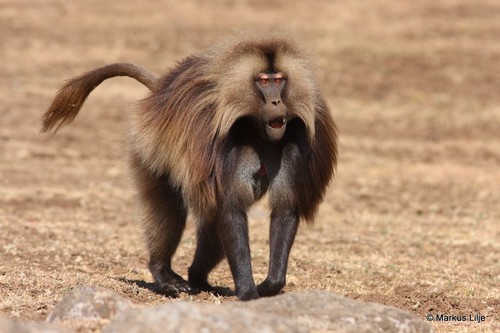
Gelada
Theropithecus gelada
Meet the 'Bleeding-Heart Monkey,' a unique grass-eating primate found only in the clouds of Ethiopia. Known for their dramatic red chest patches and massive social herds, they are the last of the ancient beast-apes.
Quick Identification
Size
Weight: 11-18.5 kg (24-41 lbs) for females, 18.5-30 kg (41-66 lbs) for males. Length: 50-75 cm (20-30 in).
Colors
Buff to dark brown fur; hairless bright red skin patch on the chest (more vibrant in dominant males); males have long, flowing capes of hair.
Key Features
- Hourglass-shaped red patch on the chest
- Long, lion-like mane on adult males
- Pale upper eyelids used for 'eyelid-flick' displays
- Short, snub-nosed facial profile
When You’ll See Them
Geographic range
Where Does the Gelada Live?
Native to the African continent, the Gelada is found exclusively within the rugged Ethiopian Highlands. This core range is concentrated in the Simien Mountains and the central plateau of Ethiopia, where the cool, thin air of the afro-alpine ecosystem supports the vast grasslands they depend on. Because they are endemic to these specific high-altitude regions, they are not found naturally anywhere else in the world.
Basemap © OpenStreetMap contributors
Behavior
Unlike many other monkeys, they do not live in trees. Instead, they are master climbers of vertical terrain, retreating to steep, rocky cliffs every evening to sleep in safety away from predators like leopards. During the day, they congregate in massive herds that can reach over 1,000 individuals, creating a noisy and vibrant spectacle of vocalizations, facial expressions, and complex social maneuvering. Interactions with humans are generally peaceful, though they may occasionally raid crops in mountain villages when natural food is scarce.
EverydayEarth exclusive
Camera Tips
To capture the best footage of Geladas, focus your camera placement on 'cliffside corridors.' These primates travel between their sleeping cliffs and their feeding plateaus every morning and evening. Position your camera along established footpaths right at the edge of the plateau escarpment. Set the camera low to the ground—about 18 to 24 inches high—to capture their unique shuffling movement and get a clear view of the distinctive chest patches.
Use a high-speed burst mode or high-frame-rate video settings. Geladas are incredibly expressive, frequently using 'lip-flips' and 'eyelid-flicks' to communicate. A standard trail camera delay might miss these fleeting social signals. Because they live in high-glare, high-altitude environments, try to angle your camera slightly away from the direct morning sun to avoid blowing out the highlights on the males' long, shaggy manes.
Avoid using food lures. Geladas are specialized grass eaters and are rarely interested in fruit or nuts; furthermore, baiting them can lead to dangerous habituation. Instead, focus on natural water sources during the dry season (October to April). Small alpine seeps or pools on the plateau are magnets for large herds and provide excellent opportunities for group shots and drinking behavior.
Lastly, prepare for the elements. The Ethiopian Highlands experience extreme temperature swings and intense UV radiation. Use high-quality lithium batteries, as standard alkaline batteries will fail in the freezing nighttime temperatures on the cliffs. Ensure your camera housing is fully weatherproof to handle the dense mountain mists that often roll in during the late afternoon.
Similar Species
Species that look similar or are commonly confused with Gelada.
Frequently Asked Questions
Record Gelada at your habitat
Connect a camera to start building your own species record — AI identifies every visitor automatically.