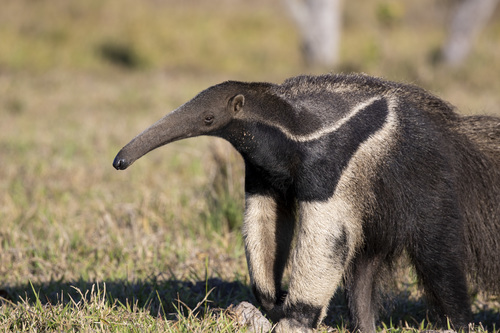
Giant Anteater
Myrmecophaga tridactyla
The giant anteater is nature's most specialized architect, featuring a two-foot tongue and claws strong enough to deter apex predators. This prehistoric-looking wanderer is a true icon of the South American wild.
Quick Identification
Size
Total length of 182 to 217 cm (6 to 7.1 ft) and weighing between 27 and 50 kg (60 to 110 lbs).
Colors
Salt-and-pepper gray or brown fur with a prominent black diagonal stripe bordered by white running from the throat to the middle of the back; dark gray limbs.
Key Features
- Elongated, tubular snout and no teeth
- Enormous, bushy 'flag' tail
- Large, sickle-shaped front claws used for digging
- Distinctive black-and-white shoulder stripe
- Walks on its knuckles to protect its claws
When You’ll See Them
Geographic range
Where Does the Giant Anteater Live?
Native to Central and South America, the giant anteater occupies a vast but increasingly fragmented territory that stretches from the southern tip of Mexico and Honduras down through the heart of Brazil to northern Argentina and Uruguay. These fascinating mammals are most commonly found in the Cerrado grasslands and the Pantanal wetlands of Brazil, which represent the core of their remaining population. While they have been extirpated from some of their former northern ranges, they remain a keystone species across the tropical and subtropical lowlands of the southern continent.
Basemap © OpenStreetMap contributors
Behavior
The giant anteater is a solitary and nomadic mammal, spending much of its life wandering through grasslands and forests in search of its next meal. Unlike its smaller relatives, the giant anteater is primarily terrestrial and rarely climbs trees. They are generally peaceful but can be formidable if cornered, standing on their hind legs and using their powerful foreclaws—which are strong enough to fight off jaguars—to defend themselves.
These creatures have a very low metabolic rate and sleep for up to 15 hours a day, often curling up in shallow depressions and using their massive, bushy tails as a thermal blanket to regulate body temperature. While they have poor eyesight and hearing, their sense of smell is roughly 40 times more sensitive than a human's, allowing them to detect insect colonies from a significant distance.
EverydayEarth exclusive
Camera Tips
Capturing a giant anteater on camera requires a focus on their foraging routes. Because they are nomadic and follow their noses, look for 'game trails' between known termite mounds or near water sources. They are creatures of habit when it comes to territory, so if you see signs of fresh digging at a mound, there is a high probability the individual will return to the area within a few days.
Mount your camera at knee height—approximately 20 to 30 inches off the ground. This ensures you capture the full profile of their long snout and bushy tail without the grass obscuring the lens. Use a wide-angle lens setting if available, as these animals are surprisingly long; a standard tight frame might only capture the head or the tail as they pass by. A high trigger speed is essential, as their steady, lumbering gait can carry them across a camera's field of view faster than you might expect.
While you cannot easily bait a giant anteater with food, they are highly attracted to water during the dry season. Setting up a camera near a secluded watering hole or a muddy wallow is your best bet for high-quality daytime footage. Additionally, ensure your camera has a strong infrared flash for night captures, as anteaters in areas with human activity often shift their behavior to become almost entirely nocturnal to avoid disturbance.
Similar Species
Species that look similar or are commonly confused with Giant Anteater.
Northern Tamandua
Much smaller, spends significant time in trees, and has a prehensile tail with less fur.
Southern Tamandua
Similar to the Northern Tamandua but found further south; lacks the giant anteater's massive size and bushy tail.
Giant Armadillo
Also a large insectivore, but covered in bony plates (armor) rather than thick fur.
Frequently Asked Questions
Record Giant Anteater at your habitat
Connect a camera to start building your own species record — AI identifies every visitor automatically.