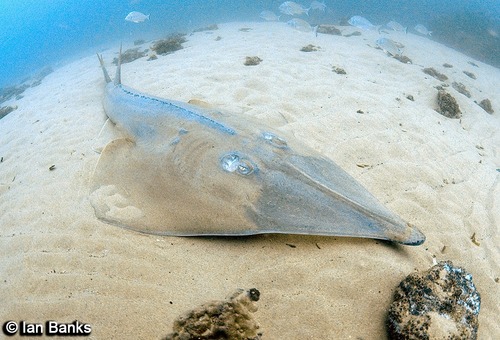
Giant Guitarfish
Glaucostegus typus
A striking blend of shark and ray, the Giant Guitarfish is a master of camouflage in the Indo-Pacific shallows. This Critically Endangered 'shovelnose' is a rare prize for coastal observers and underwater photographers.
Quick Identification
Size
Reaches up to 2.7 m (8.9 ft) in length and can weigh over 100 kg (220 lbs).
Colors
Greyish-brown to yellowish-brown dorsal surface, often with a paler, translucent-looking snout; underside is uniform white or cream.
Key Features
- Distinctive triangular, wedge-shaped head
- Two large, shark-like dorsal fins positioned well behind the pelvic fins
- Powerful, shark-like tail with a well-developed caudal fin
- Pale or translucent patches on the sides of the snout
When You’ll See Them
Geographic range
Where Does the Giant Guitarfish Live?
The Giant Guitarfish is native to the warm coastal waters of the central Indo-Pacific, with a range extending from the eastern shores of India and Sri Lanka through Southeast Asia to the East China Sea. It is particularly common in the tropical waters of Northern Australia, where it inhabits the shallow flats of the Great Barrier Reef and the Northern Territory. While historically found across the Solomon Islands and Papua New Guinea, its populations are now increasingly concentrated in areas with lower fishing pressure.
Basemap © OpenStreetMap contributors
Behavior
The Giant Guitarfish is a coastal specialist that spends much of its time cruising over sandy or muddy bottoms. Despite its shark-like appearance, it is a member of the ray family and shares many of their benthic habits. It often buries itself partially in the substrate to ambush prey or to avoid detection by larger predators, such as Great Hammerheads. It is generally a solitary species, though it may congregate in specific nursery areas or during seasonal movements.
While they are powerful swimmers, Giant Guitarfish are considered harmless to humans unless provoked. In areas where coastal development is high, they are known to enter very shallow flats and estuaries, sometimes coming within a few feet of the shoreline. They exhibit a slow-moving, graceful swimming style, using their muscular tail for propulsion rather than flapping their pectoral fins like stingrays.
EverydayEarth exclusive
Camera Tips
Capturing a Giant Guitarfish on camera requires a specialized approach since they are almost exclusively aquatic. For those living on canals or coastal properties, a dock-mounted underwater camera is the most effective tool. Position the camera between 1 and 3 meters deep, facing toward a sandy patch of the sea floor rather than into open blue water. Because these fish are bottom-dwellers, a low-angle view (about 30 degrees from the bottom) will provide the best profile shots of their unique 'guitar' shape.
AI-powered cameras like the ones supported by EverydayEarth work best when there is high contrast. Since these rays are camouflaged to match the sand, ensure your camera has a clear line of sight and use a polarizing filter if the camera is mounted above water to cut through surface glare. If using an underwater housing, keep the dome or lens clean of algae and silt, as the Giant Guitarfish often stirs up the bottom when feeding, which can trigger motion sensors but result in cloudy footage.
Timing is critical for these coastal wanderers. They are most active during rising tides when they follow the incoming water into shallow estuaries and mangroves to hunt. Set your camera to record high-frame-rate video (60fps or higher) to capture the fluid movement of their tail. If you are using a lure, avoid traditional bait which may attract unwanted scavengers; instead, focus on areas near natural oyster reefs or seagrass beds where their natural prey—crabs and small fish—are abundant.
Similar Species
Species that look similar or are commonly confused with Giant Guitarfish.
Frequently Asked Questions
Record Giant Guitarfish at your habitat
Connect a camera to start building your own species record — AI identifies every visitor automatically.