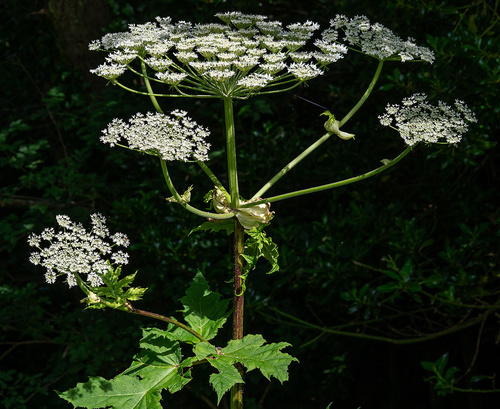
Giant Hogweed
Heracleum mantegazzianum
A towering and hazardous invasive, the Giant Hogweed commands attention with its massive white blooms and prehistoric scale.
Quick Identification
Size
Height of 2 to 5.5 meters (7 to 18 feet) with leaves spreading up to 1.5 meters (5 feet) wide.
Colors
Bright green stems with distinct reddish-purple splotches; large clusters of tiny white flowers; coarse white bristles at the base of leaf stalks.
Key Features
- Massive umbrella-shaped white flower heads up to 2.5 feet wide
- Hollow, rigid stems with prominent purple mottling and stiff hairs
- Enormous, deeply incised leaves with sharp, jagged edges
- Towering height significantly exceeding native lookalikes
When You’ll See Them
Behavior
Giant Hogweed is a monocarpic perennial, a fascinating botanical strategy where the plant grows for several years—typically three to five—to build up energy before flowering once, setting thousands of seeds, and then dying. During its vegetative stage, it forms a massive rosette of leaves that can shade out almost all native competition, creating a monoculture that destabilizes local ecosystems. It is notoriously invasive, particularly in riparian zones where its seeds can use water currents to travel long distances.
Beyond its ecological impact, the plant is famous for its chemical defense mechanism. It produces a clear, watery sap containing furanocoumarins. When this sap touches human skin and is subsequently exposed to ultraviolet light (sunlight), it triggers a severe reaction called phytophotodermatitis. This results in painful, liquid-filled blisters and can lead to permanent scarring or even blindness if the sap enters the eyes. Because of this, the plant is widely regarded as a significant public health hazard.
EverydayEarth exclusive
Camera Tips
Capturing the sheer scale of Giant Hogweed on a trail camera requires careful positioning. Because this plant can reach heights of 18 feet, standard chest-high camera mounting will only capture the base of the stem. To get the full 'cartwheel' flower head in frame, place your camera at least 20 feet back from the specimen or mount it higher on a neighboring tree with a downward tilt. If you are monitoring for invasive growth on your property, a wide-angle lens is essential to document the spread of the large basal leaves in early spring.
Time-lapse mode is the most effective way to utilize AI cameras with Giant Hogweed. During the 'bolting' phase in late spring, the plant can grow several inches per day. Setting your camera to take a photo every 2-4 hours allows you to create a dramatic visual record of its rapid ascent. Additionally, the massive white flower heads are highly attractive to pollinators such as hoverflies and bees. To capture these interactions, use a high-speed trigger setting, as the movement of insects against the white petals can often cause overexposure if the camera doesn't adjust quickly to the bright white surface of the bloom.
Safety is the most important consideration when setting up equipment. Never clear a line of sight for your camera by hand; even dead, brown stalks can contain active sap. Use long-handled tools or a weed trimmer while wearing full protective clothing (gloves, long sleeves, and eye protection). For the best lighting, try to position your camera so it is not facing directly into the midday sun, as the white flowers are highly reflective and can 'wash out' in high-contrast situations. Early morning or late afternoon light will highlight the fine, white bristles on the stems, which are a key identification feature.
Similar Species
Species that look similar or are commonly confused with Giant Hogweed.
Frequently Asked Questions
Record Giant Hogweed at your habitat
Connect a camera to start building your own species record — AI identifies every visitor automatically.