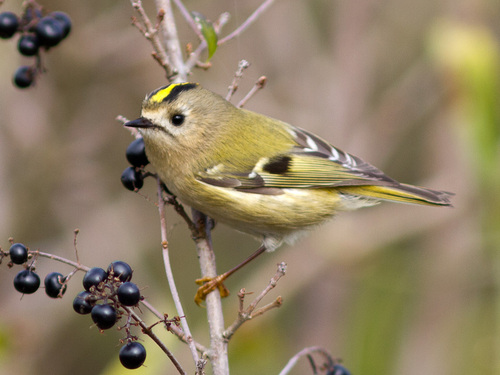
Goldcrest
Regulus regulus
As Europe's smallest bird, the Goldcrest is a featherweight marvel with a fiery crown. This energetic 'petty king' is a master of the treetops, bringing a flash of gold to evergreen gardens across the continent.
Quick Identification
Size
Length: 8.5–9.5 cm (3.3–3.7 in); Wingspan: 13.5–15.5 cm (5.3–6.1 in); Weight: 4.5–7 g (0.16–0.25 oz)
Colors
Olive-green upperparts, pale buff underparts, with a bright yellow (female) or orange-centered (male) crown stripe bordered by black.
Key Features
- Tiny, rounded body with a very short tail
- Bright yellow or orange crest stripe with black borders
- Pale wing bars and a distinctively thin, needle-like beak
- Plain face without a white eyebrow stripe, unlike the Firecrest
When You’ll See Them
Geographic range
Where Does the Goldcrest Live?
The Goldcrest is native to the vast Palearctic region, stretching from Western Europe and the British Isles across Russia to the islands of Japan. It is a common resident across much of Europe, including countries like Germany, France, and Scandinavia, though northern populations typically migrate to the Mediterranean or North Africa for the winter. In the UK and Ireland, they are found year-round, while further east, their range extends into the Himalayas and across temperate Asia.
Basemap © OpenStreetMap contributors
Behavior
Goldcrests are hyperactive birds that are almost constantly in motion. They spend the vast majority of their daylight hours flitting through the canopy of trees, particularly conifers, where they perform acrobatic maneuvers to find food. They are often seen hovering momentarily at the tips of branches to pluck tiny spiders or insect larvae from the underside of needles. Their flight is weak and undulating, but their agility within thick foliage is unmatched.
These birds are highly social and are frequently found in mixed-species foraging flocks during the winter, often traveling alongside tits and treecreepers. Despite their minute size, they are surprisingly bold and can be approached closely if one remains still. During the breeding season, the male will raise his colorful crest feathers in a dramatic display to defend his territory or attract a mate, transforming the thin stripe into a vibrant crown.
EverydayEarth exclusive
Camera Tips
Because Goldcrests are so tiny and move with such speed, they can be a challenge for standard motion-activated cameras. To successfully capture them, your camera placement should be focused on specific 'stopping points.' Water is the best attractant; a shallow birdbath or a garden pond with a gentle dripper will often entice them to descend from the high canopy to drink and bathe. Position your camera just 2–3 feet from the water source to ensure the small details of the crest are visible.
If you don't have a water feature, focus your camera on the outer tips of evergreen branches, such as Yew, Ivy, or Pine. Goldcrests prefer foraging on the very ends of branches rather than near the trunk. A height of 4 to 6 feet is ideal for backyard cameras. Because they are so small, ensure your camera has a macro-friendly focus or is positioned far enough away that the autofocus doesn't hunt, but close enough to trigger the PIR sensor.
In the winter, Goldcrests can be attracted to feeders, but they rarely eat seeds. Instead, try placing fat balls or suet in a cage near thick evergreen cover. They are more likely to visit if the feeder is placed within a foot of a protective bush. Use a high-speed shutter or burst mode setting if your camera allows it, as a Goldcrest rarely stays in one spot for more than a second or two. Early morning light provides the best opportunity to see the male's crest glow in the sun.
Similar Species
Species that look similar or are commonly confused with Goldcrest.
Frequently Asked Questions
Record Goldcrest at your habitat
Connect a camera to start building your own species record — AI identifies every visitor automatically.