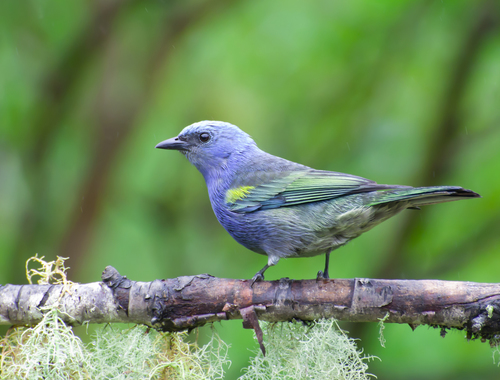
Golden-chevroned Tanager
Thraupis ornata
A dazzling endemic of the Brazilian Atlantic Forest, the Golden-chevroned Tanager is a social garden visitor famous for its shimmering violet-blue plumage and iconic yellow shoulders.
Quick Identification
Size
Approximately 18 cm (7 inches) in length; weighs between 30 and 36 grams (1.1 to 1.3 oz).
Colors
Pale grayish-blue body with a subtle violet or purple sheen. Bright golden-yellow patches on the shoulders (lesser wing coverts) are the primary identifier. Wings and tail are dark charcoal gray.
Key Features
- Bright golden-yellow shoulder patch
- Pale blue-gray body with violet tint
- Stout, dark bill
- Endemic to Brazil's Atlantic Forest
When You’ll See Them
Geographic range
Where Does the Golden-chevroned Tanager Live?
The Golden-chevroned Tanager is a South American treasure found exclusively within the borders of Brazil. It is a signature species of the Atlantic Forest biome, stretching from the northern state of Bahia southward to Rio Grande do Sul. While it prefers the humid coastal lowlands and interior mountains, it has successfully expanded into major urban centers like Rio de Janeiro and São Paulo wherever greenery is preserved.
Basemap © OpenStreetMap contributors
Behavior
The Golden-chevroned Tanager is an energetic and highly social bird, usually seen in pairs or small family groups. They are extremely well-adapted to human environments, frequently inhabiting suburban gardens, orchards, and urban parks where native trees are present. They are bold around human dwellings and are often the first visitors to arrive at garden bird feeders stocked with fresh fruit.
In the wild, these tanagers are active foragers that move through the middle and upper layers of the forest canopy. They frequently participate in mixed-species flocks, moving alongside other tanagers like the Sayaca Tanager and various honeycreepers. Their vocalizations are a series of high-pitched, metallic 'tsep' notes and a hurried, squeaky song delivered from high perches at dawn.
EverydayEarth exclusive
Camera Tips
To successfully capture the Golden-chevroned Tanager on your AI camera, focus on fruit-bearing locations. These birds are highly motivated by fruit and will return multiple times a day to a platform feeder stocked with halved papayas, bananas, or guavas. Position your camera at a height of 4 to 6 feet, mirroring their natural foraging height, and ensure the lens is roughly 3 to 5 feet from the food source to get clear, detailed images of their plumage.
Lighting is the most critical factor for this species. Their blue-gray feathers have a subtle violet iridescence that only pops in good light; in deep shade, they can look like a drab, uniform gray. Aim your camera to catch the soft light of the early morning or late afternoon. If you are placing a camera in a more natural forest setting, look for flowering bromeliads or water-filled tree holes, as these birds are frequent bathers and will visit water sources to drink and preen.
Since they are fast-moving and social, setting your camera to 'Burst Mode' or capturing 10-second video clips is better than single stills. This allows you to see the social interactions between pairs and ensures you capture the moment they lift their wings, revealing the brilliant golden 'chevron' patch on their shoulders. Because they are year-round residents in Brazil, you can keep your camera active through all seasons, though you'll see increased activity during the spring nesting season when they are busy gathering both fruit and insects.
Similar Species
Species that look similar or are commonly confused with Golden-chevroned Tanager.
Frequently Asked Questions
Record Golden-chevroned Tanager at your habitat
Connect a camera to start building your own species record — AI identifies every visitor automatically.