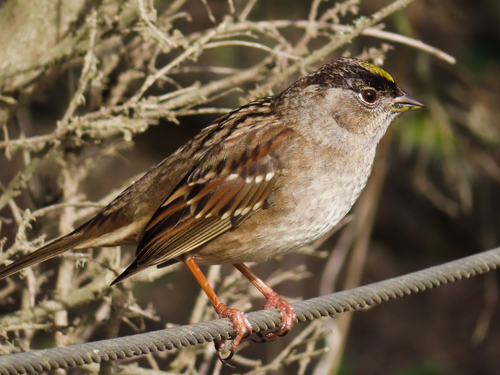
Golden-crowned Sparrow
Zonotrichia atricapilla
With their signature golden crown and hauntingly beautiful three-note song, these large sparrows are the quintessential winter companions of the American West.
Quick Identification
Size
Length: 15–18 cm (6–7 in); Wingspan: 24–27 cm (9.5–10.5 in); Weight: 23–35 g (0.8–1.2 oz)
Colors
Dull brownish-gray body with heavy dark streaks on the back; the defining feature is a vibrant yellow crown stripe bordered by thick black stripes on the head, which fades slightly in non-breeding plumage.
Key Features
- Bright golden-yellow crown patch
- Broad black stripes bordering the crown
- Chunky, large-bodied sparrow profile
- Double white wing bars
When You’ll See Them
Geographic range
Where Does the Golden-crowned Sparrow Live?
Native to the western reaches of North America, the Golden-crowned Sparrow is a classic bird of the Pacific Flyway. During the summer, they breed in the rugged shrublands of Alaska and northwestern Canada, including the Yukon and British Columbia. As autumn arrives, they migrate south to spend their winters along the Pacific coast, stretching from southern British Columbia down through the United States to northern Baja California in Mexico. Their winter presence is most concentrated in the coastal states of Washington, Oregon, and California, where they are a staple of the backyard birding scene.
Basemap © OpenStreetMap contributors
Behavior
Golden-crowned Sparrows are highly social birds, particularly during the winter months when they form loose, stable flocks. Interestingly, research has shown that these birds often return to the exact same 'winter neighborhood' year after year, frequently associating with the same individuals. They are ground-focused foragers, often seen hopping through leaf litter or underbrush with a characteristic 'double-scratch' motion to uncover seeds and insects.
While they can be shy and quick to retreat into dense thickets when disturbed, they are common visitors to suburban gardens that provide adequate cover. They are most famous for their mournful, three-note whistled song, which sounds like a minor-key 'oh-dear-me,' often heard echoing through coastal scrub or garden edges on overcast winter days. Unlike many other songbirds, they are known to sing throughout the winter, not just during the breeding season.
EverydayEarth exclusive
Camera Tips
To capture high-quality footage of a Golden-crowned Sparrow, camera placement is everything. Because these birds are ground-foragers that rarely venture far from safety, place your AI-powered camera 6 to 12 inches off the ground, aimed toward a clear patch of dirt or mulch directly adjacent to a dense shrub, brush pile, or hedgerow. They feel most secure when a quick escape into cover is possible, so avoid placing cameras in the middle of wide-open lawns.
Attracting them to your camera's field of view is relatively simple with the right bait. Spread a mix of white proso millet, sunflower hearts, or a high-quality wild bird blend on the ground. Unlike chickadees that grab a seed and fly away, Golden-crowned Sparrows will often linger in front of the lens for several minutes, scratching and feeding, which provides excellent opportunities for the AI to trigger and record extended behavior clips.
Lighting can be a challenge since these birds prefer the 'edge' habitats which are often shaded. If your camera has adjustable settings, ensure it is optimized for high shadow detail. Since they are most active in the early morning and late afternoon, try to position your camera facing north or south to avoid the direct glare of a low sun, which can wash out the delicate yellow of their crown in your photos and videos.
During the dry months in their wintering range, a ground-level water feature or a shallow birdbath can be an even stronger draw than food. A dripping water sound is particularly effective at bringing them out of the brush. If using a birdbath, ensure it has a rough bottom for grip and is no more than two inches deep, as these sparrows are cautious bathers.
Similar Species
Species that look similar or are commonly confused with Golden-crowned Sparrow.
White-crowned Sparrow
Features bold black-and-white head stripes and lacks the yellow crown patch.
White-throated Sparrow
Has a distinct white throat patch and yellow spots (lores) between the eye and the bill, rather than on the crown.
Harris's Sparrow
Much larger with a distinctive black bib and crown, lacking any yellow markings.
Frequently Asked Questions
Record Golden-crowned Sparrow at your habitat
Connect a camera to start building your own species record — AI identifies every visitor automatically.