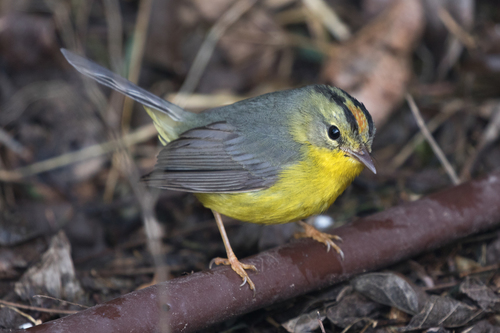
Golden-crowned Warbler
Basileuterus culicivorus
With its brilliant golden crown and restless energy, this tiny songbird is a jewel of the American tropics. A master of the undergrowth, the Golden-crowned Warbler is a year-round delight for backyard observers from Mexico to Argentina.
Quick Identification
Size
Length: 12–13 cm (4.7–5.1 in); Weight: 7.5–11 g (0.26–0.39 oz)
Colors
Olive-green upperparts and bright yellow or white underparts; grey head with a prominent golden-yellow crown stripe bordered by thick black lines.
Key Features
- Bright golden-yellow crown stripe bordered by black
- Grey face and nape contrasting with olive back
- Frequent wing-flicking and tail-wagging behavior
- Small, thin insectivore bill
When You’ll See Them
Geographic range
Where Does the Golden-crowned Warbler Live?
Native to the Western Hemisphere, the Golden-crowned Warbler boasts an expansive range that begins in the thorn scrubs of northeastern Mexico and extends through the heart of Central America. In South America, it is found across a massive territory encompassing the Guyanas, Brazil, and southward into northern Argentina and Uruguay. While it avoids the highest peaks of the Andes and the deepest, flooded parts of the Amazon, it is a staple of nearly every other tropical and subtropical woodland in its path.
Basemap © OpenStreetMap contributors
Behavior
The Golden-crowned Warbler is a bundle of near-constant energy, characterized by its restless foraging style. It moves rapidly through the middle and lower strata of the forest, frequently flicking its wings and pumping its tail as it searches for prey. While they can be found in pairs or small family units, they are also quintessential participants in mixed-species foraging flocks, often acting as sentinels that alert other birds to potential threats.
In residential areas, these warblers show a surprising amount of tolerance for human presence, provided there is enough dense vertical cover. They are vocal birds, often giving away their location with a series of sharp 'tsip' calls or a high-pitched, accelerating song that blends into the tropical soundscape. Unlike many migratory warblers, they are largely sedentary, meaning once you find a pair in your backyard or local park, they are likely to be year-round residents.
EverydayEarth exclusive
Camera Tips
To capture the Golden-crowned Warbler on camera, you must focus on the 'vertical mid-section' of your backyard habitat. These birds rarely forage on the open ground and even more rarely at the very tops of tall trees; they prefer the dense 'vines and twigs' zone between 2 and 8 feet high. Mount your camera on a sturdy branch or a specialized pole aimed at a horizontal perching spot near dense foliage. Because they move so quickly, a camera with a trigger speed of 0.2 seconds or faster is highly recommended to avoid getting nothing but a blurry tail in the frame.
Water is the absolute best lure for this species. A birdbath with a solar-powered dripper or a small recirculating fountain will attract them much more effectively than a seed feeder, which they will generally ignore. Position your AI-powered camera 3 to 5 feet away from the water source, ensuring the lens is at the same horizontal level as the water's surface. This 'eye-level' angle provides the most intimate shots and helps the AI identification software catch the golden crown stripe when the bird tilts its head down to drink.
Lighting is your biggest challenge in their preferred shady habitats. Try to position your camera so it faces away from the morning sun to avoid silhouetting. If your camera has a 'burst mode' or 'Photo + Video' setting, use it. The Golden-crowned Warbler has a habit of flicking its wings just before it takes flight; a burst of 3-5 photos increases your chances of capturing that iconic golden crown in full display. During the breeding season, look for them carrying nesting material like fine grasses or spider webs, which makes for excellent behavioral footage.
Similar Species
Species that look similar or are commonly confused with Golden-crowned Warbler.
Frequently Asked Questions
Record Golden-crowned Warbler at your habitat
Connect a camera to start building your own species record — AI identifies every visitor automatically.