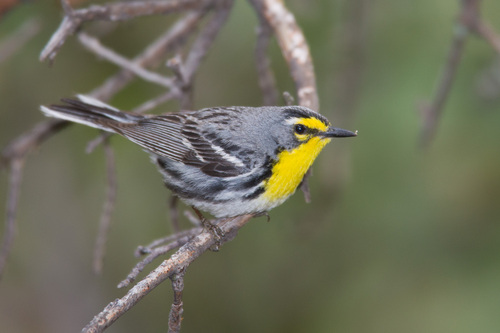
Grace's Warbler
Setophaga graciae
A vibrant jewel of the Ponderosa pines, the Grace's Warbler is a stunning songbird that defines the high-altitude forests of the American Southwest with its brilliant yellow throat and rhythmic trill.
Quick Identification
Size
Length: 4.3–5.1 in (11–13 cm); Wingspan: 7.5–8.3 in (19–21 cm); Weight: 0.25–0.32 oz (7–9 g)
Colors
Slate-gray upperparts with black streaking; bright yellow throat and upper breast; white belly and undertail; yellow eyebrow stripe; two white wing bars.
Key Features
- Bright yellow throat and upper breast
- Broad yellow stripe above the eye that turns white
- Gray back with distinct black streaks
- Specialist of high-altitude pine forests
When You’ll See Them
Geographic range
Where Does the Grace's Warbler Live?
The Grace's Warbler is a signature species of the mountainous regions of North and Central America. Its primary breeding grounds are located in the Southwestern United States, spanning across Arizona, New Mexico, southern Colorado, and Utah. As the seasons change, these birds migrate south through the highlands of Mexico and into the pine forests of Central America, reaching as far as Nicaragua and Honduras, where resident populations can also be found year-round.
Basemap © OpenStreetMap contributors
Behavior
While they are socially monogamous during the breeding season, Grace's Warblers often join mixed-species foraging flocks during the winter or during migration. You might see them traveling alongside Nuthatches, Chickadees, and other warblers. Despite their high-altitude lifestyle, they are surprisingly approachable if they happen to descend for water or during a brief stopover during migration.
EverydayEarth exclusive
Camera Tips
Capturing the Grace's Warbler on an AI-powered camera is a rewarding challenge because of their preference for the high canopy. To bring them down to camera level, your best strategy is to offer a reliable water source. In the arid environments where they live, a birdbath with a solar-powered dripper or a small bubbling fountain is an irresistible magnet. Position your camera at eye level with the water source, roughly 3 to 5 feet away, to capture clear, high-resolution footage as they descend to drink or bathe.
Since these birds are fast-moving and quite small, use a camera with a high trigger speed or set your device to record short video clips rather than still photos. If your camera software allows, increase the motion sensitivity to 'High' to ensure the sensor picks up their light movements. Because they are active early in the morning, ensure your camera is positioned to avoid direct lens flare from the rising sun, which can wash out the vibrant yellow of their throat.
While they don't typically visit seed feeders, you can sometimes tempt them with high-quality suet or mealworms during the early spring when they first arrive on their breeding grounds. Place these lures in or near a pine tree to make the bird feel secure in its natural habitat. Check your camera footage most frequently during May and June, which is the peak of their activity when males are most territorial and mobile.
Similar Species
Species that look similar or are commonly confused with Grace's Warbler.
Yellow-throated Warbler
Features a distinct black mask and a white patch on the side of the neck, whereas Grace's has a gray face with a yellow eyebrow.
Townsend's Warbler
Has a much darker, black-to-greenish cheek patch and more extensive yellow on the face and breast.
Black-throated Gray Warbler
Shares the gray and white tones but lacks the bright yellow throat, featuring only a tiny yellow spot in front of the eye.
Frequently Asked Questions
Record Grace's Warbler at your habitat
Connect a camera to start building your own species record — AI identifies every visitor automatically.