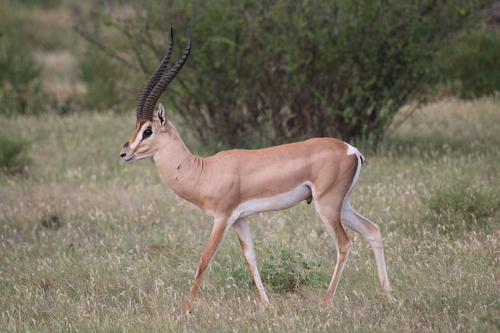
Grant's Gazelle
Nanger granti
The Grant's Gazelle is a masterpiece of desert adaptation, roaming the vast East African plains with an elegance that defies the harsh environment. Known for its striking lyre-shaped horns and resilient nature, it remains one of the savannah's most enduring icons.
Quick Identification
Size
Shoulder height: 75–95 cm (30–37 in); Weight: 45–80 kg (100–175 lb)
Colors
Pale fawn-colored coat with a bright white underbelly; white rump patch with black vertical borders; distinct black facial stripes from the eye to the nose.
Key Features
- Large, lyre-shaped ringed horns (present in both sexes)
- Distinct white rump patch extending above the tail
- Prominent dark facial stripe running from eye to muzzle
- Slender, long-legged build with a fawn-colored coat
When You’ll See Them
Geographic range
Where Does the Grant's Gazelle Live?
Native to the African continent, Grant's Gazelle is a hallmark species of the East African savannah. Its core range spans from northern Tanzania through the heart of Kenya, extending into southern Ethiopia and South Sudan, with populations also reaching the Somali coast. These gazelles are uniquely adapted to the Rift Valley's diverse topography, thriving from coastal lowlands to high-altitude plateaus.
Basemap © OpenStreetMap contributors
Behavior
Grant's Gazelles are highly social and adaptable antelopes, typically found in herds ranging from half a dozen to over thirty individuals. Their social structure is dynamic; dominant males are intensely territorial during the breeding season, marking large swathes of land to attract groups of females. Outside of breeding times, they often form loose associations, including bachelor herds of younger males and nursery groups of females and their fawns.
One of their most fascinating behaviors is their ability to thrive in extremely arid conditions. Unlike the similar-looking Thomson's Gazelle, Grant's Gazelle can go long periods without drinking standing water, as they are expert at extracting moisture from the vegetation they consume. When threatened by predators like cheetahs or lions, they perform a behavior called 'stotting'—high-pitched, stiff-legged leaps that signal to the predator that the gazelle is fit, healthy, and likely too fast to be caught.
EverydayEarth exclusive
Camera Tips
To successfully capture Grant's Gazelle on a trail camera, placement is everything. These animals prefer open vistas where they can spot predators from a distance, so avoid thick brush. Mount your camera on a fence post or a lone acacia tree approximately 3.5 to 4 feet (1.1 to 1.2 meters) high. This height ensures you capture the full profile of the animal, including its impressive horns, rather than just its legs or back. Angle the camera slightly downward if you are monitoring a slope or a specific game trail.
While they don't depend on water as much as other species, Grant's Gazelles are highly attracted to mineral licks and areas with fresh, succulent growth after a light rain. If you have a larger property or are monitoring a wild area, look for 'latrines'—areas with concentrated dung—as these are frequently revisited by territorial males. Setting up near these spots almost guarantees frequent sightings as the males return to mark their territory.
For the best image quality, use a camera with a very fast trigger speed (0.4 seconds or faster) because these gazelles can move surprisingly quickly even when just walking. Use a 'No-Glow' or 'Black LED' infrared flash for nighttime shots; although they are primarily diurnal, they do move at night, and standard 'Glow' LEDs can spook the herd. In the heat of the day, they often rest under the shade of flat-topped acacia trees, making these shaded spots prime locations for midday 'candid' captures of the herd ruminating.
Similar Species
Species that look similar or are commonly confused with Grant's Gazelle.
Frequently Asked Questions
Record Grant's Gazelle at your habitat
Connect a camera to start building your own species record — AI identifies every visitor automatically.