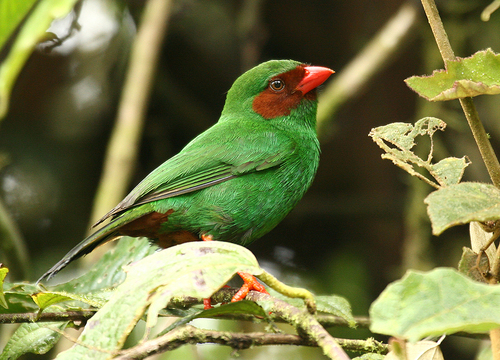
Grass-green Tanager
Chlorornis riefferii
Glowing like an emerald in the misty Andean cloud forests, the Grass-green Tanager is a stunning sight. With its vivid green plumage and striking chestnut face, it is a master of camouflage in the moss-draped canopy.
Quick Identification
Size
Length of 20 cm (7.9 in); weight 48–56 g (1.7–2.0 oz)
Colors
Luminous grass-green body, deep chestnut-maroon face and throat, bright reddish-orange bill and legs
Key Features
- Vibrant grass-green plumage across entire body
- Distinctive chestnut-red face mask and throat
- Bright reddish-orange bill and legs
- Pale blue to whitish vent and lower belly area
When You’ll See Them
Geographic range
Where Does the Grass-green Tanager Live?
Where does the Grass-green Tanager live? This stunning bird is a resident of the high-altitude cloud forests of the South American Andes. Its native range forms a narrow corridor stretching from northern Venezuela and Colombia, south through the moist slopes of Ecuador and Peru, and ending in the yungas of western Bolivia. It is a specialist of the temperate zone, rarely descending into the tropical lowlands.
Basemap © OpenStreetMap contributors
Behavior
The Grass-green Tanager is a charismatic and social inhabitant of the Andean cloud forests. Unlike many of its more frantic relatives, this species often moves with a steady, deliberate pace. It is frequently seen in pairs or small family groups, and it is a quintessential member of mixed-species foraging flocks, often acting as a core species that helps lead these diverse groups through the canopy.
These birds are known for their 'creeping' foraging style, where they hop along horizontal, moss-covered branches to inspect epiphytes for hidden treats. While they are primarily forest-dependent, they are remarkably bold and will often allow observers to get quite close, especially when they are focused on a particularly productive fruiting tree. They communicate with high-pitched 'tsip' calls that help keep the flock together in the often-dense mountain mist.
EverydayEarth exclusive
Camera Tips
To capture the Grass-green Tanager on camera, you need to think vertically. These birds spend the majority of their time in the mid-to-upper canopy, so mounting your camera on a high balcony or using a tree-climbing mount is essential. Focus your lens on horizontal, moss-laden branches which serve as 'highways' for the species as they forage for insects and berries.
If you are setting up a camera in a backyard that borders a forest, plant native berry-producing shrubs from the Melastomataceae family. These are a natural magnet for the species. For a more direct lure, a platform feeder stocked with halved bananas or papaya can be very effective, though it may take some time for the birds to descend from the safety of the canopy to visit a new feeding station.
Lighting in the cloud forest is notoriously tricky. The Grass-green Tanager’s plumage is so vibrant that it can easily 'blow out' in direct sunlight, while the deep chestnut face can disappear in shadows. Use a camera with a high dynamic range and set your exposure compensation to -0.3 or -0.7 to preserve the detail in the green feathers. Because they move deliberately, you don't need an ultra-fast trigger speed, but a high-resolution setting is recommended to capture the intricate texture of their moss-like plumage.
The best time for filming is immediately after dawn when the forest mist is still present but light levels have risen enough for a clear shot. Position your camera to face away from the rising sun to avoid lens flare. If your camera has a 'time-lapse' mode, setting it to take a photo every 30 seconds near a known fruiting tree can often yield better results than relying on motion sensors, which can be triggered by swaying mossy branches in the mountain wind.
Similar Species
Species that look similar or are commonly confused with Grass-green Tanager.
Frequently Asked Questions
Record Grass-green Tanager at your habitat
Connect a camera to start building your own species record — AI identifies every visitor automatically.