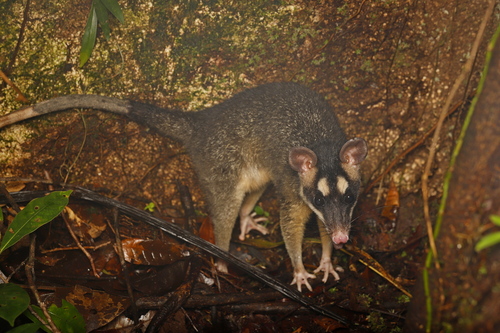
Gray Four-eyed Opossum
Philander opossum
Famed for the white spots that look like a second set of eyes, the Gray Four-eyed Opossum is one of the most charismatic and agile marsupials of the South American tropics.
Quick Identification
Size
Total length of 40–60 cm (16–24 in), including the tail; weight typically ranges between 200–700 g (7–25 oz).
Colors
Slate gray to dark gray upper body with a contrasting creamy white or yellowish underside; distinctive white spots above each eye and a black facial mask.
Key Features
- Two prominent white spots above the eyes
- Prehensile tail with a white-tipped end
- Naked, rounded black ears
- Dense, soft gray fur with a pale belly
When You’ll See Them
Geographic range
Where Does the Gray Four-eyed Opossum Live?
Native to the northern tropical regions of South America, the Gray Four-eyed Opossum is a staple of the Guiana Shield. Its core range encompasses the lush rainforests of Guyana, Suriname, and French Guiana, while extending southward into the northern reaches of the Brazilian Amazon. Within this region, it is a highly successful inhabitant of both pristine wilderness and human-altered landscapes, provided there is enough cover and moisture to suit its needs.
Basemap © OpenStreetMap contributors
Behavior
The Gray Four-eyed Opossum is a remarkably agile and high-strung marsupial compared to its slower-moving relatives. Unlike the Virginia Opossum, which is famous for 'playing dead,' this species is known for its feisty temperament and will hiss or bite if cornered. It is a strictly nocturnal creature, spending its nights navigating the forest floor and low-level branches with impressive speed and coordination.
While primarily terrestrial, they are excellent climbers and capable swimmers, often found near streams or flooded forest areas. They are solitary animals that maintain home ranges, though they are not strictly territorial. In backyard settings, they are shy but persistent, often returning to the same spot night after night if a reliable food source like a fallen fruit tree or a compost bin is discovered.
EverydayEarth exclusive
Camera Tips
To capture high-quality footage of the Gray Four-eyed Opossum, camera placement is everything. These marsupials are primarily terrestrial travelers, so mount your camera low—about 15 to 30 centimeters (6 to 12 inches) off the ground. Aiming the lens along natural 'corridors' like fallen logs, the base of large trees, or along the edges of garden fences will yield the best results, as they prefer to stay near cover rather than crossing open lawns.
Baiting is highly effective for this species due to their opportunistic nature. A mash of overripe bananas or papayas mixed with a little honey is an irresistible lure for their sweet tooth. Alternatively, for a scent that carries further through the humid night air, a small amount of pungent wet cat food can attract them from a distance. Place the bait roughly 2 to 3 meters in front of the camera to ensure the animal stays in the frame long enough for the sensor to trigger.
Because these opossums move quite quickly and are constantly twitching their noses and ears, use a fast shutter speed or a 'Rapid Fire' burst mode. If your camera supports it, short 10-15 second video clips are often better than photos for identifying the 'four-eyed' spots, which can sometimes be blurred in still shots. Ensure your infrared flash is set to medium intensity; their pale underbellies and white eye spots can easily 'white out' or overexpose if the flash is too bright at close range.
Similar Species
Species that look similar or are commonly confused with Gray Four-eyed Opossum.
Frequently Asked Questions
Record Gray Four-eyed Opossum at your habitat
Connect a camera to start building your own species record — AI identifies every visitor automatically.