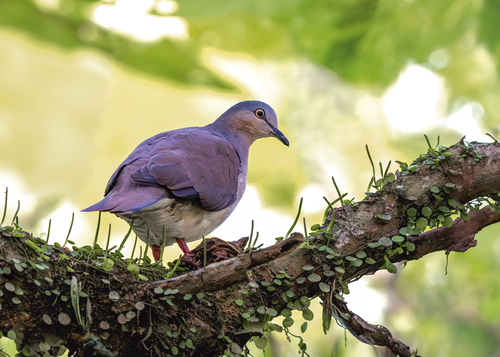
Gray-headed Dove
Leptotila plumbeiceps
A subtle beauty of the tropical undergrowth, the Gray-headed Dove is a master of camouflage and a treat for backyard observers in Central America. With its soft gray crown and coral-red legs, this terrestrial dove brings a touch of forest elegance to any camera feed.
Quick Identification
Size
23-26 cm (9-10 inches) in length; 135-180g (4.8-6.3 oz)
Colors
Soft blue-gray forehead and crown; olive-brown back and wings; pale pinkish-gray breast; white belly; red legs; dark tail with white outer tips.
Key Features
- Distinctive blue-gray crown and nape
- Pale pinkish wash on throat and breast
- White-tipped outer tail feathers visible in flight
- Bright red or coral-colored legs
When You’ll See Them
Geographic range
Where Does the Gray-headed Dove Live?
The Gray-headed Dove is a native of the Neotropics, primarily inhabiting the humid lowlands and foothills of Central America. Its range extends from the Gulf slope of eastern Mexico through Belize, Guatemala, and Honduras, reaching as far south as Panama and northwestern Colombia. While it is a non-migratory resident across its range, its presence is most concentrated in undisturbed forest edges and lush, shaded agricultural zones.
Basemap © OpenStreetMap contributors
Behavior
The Gray-headed Dove is a secretive, primarily terrestrial bird that spends most of its time walking quietly through the leaf litter of forest floors. Unlike many other pigeons and doves that congregate in large flocks, this species is typically seen alone or in pairs. It is known for its shy demeanor, often freezing or walking into dense cover when approached rather than taking flight.
Its call is a mournful, low-pitched 'hooo-ooo,' which is often the only sign of its presence in thick undergrowth. When it does fly, the movement is fast and direct, though it rarely travels long distances through the air. In backyard settings that border woodlands, they may become habituated to humans if they feel secure under thick canopy cover.
EverydayEarth exclusive
Camera Tips
To capture high-quality footage of the Gray-headed Dove, camera placement is everything. Since this species is almost exclusively terrestrial, place your camera just 6 to 12 inches off the ground. Aim the lens at a cleared patch of leaf litter near the edge of dense shrubbery or ornamental gardens. These doves prefer 'dappled light' environments, so look for spots where sunlight filters through the canopy rather than wide-open, sunny lawns.
Because they are wary of movement, use a camera with a high-speed trigger and a silent shutter. If you are using a feeder, don't use elevated hanging ones; instead, scatter a mix of cracked corn and small seeds directly on the ground. A shallow ground-level water basin or birdbath is also an excellent lure, as these doves need to drink daily and prefer doing so in the safety of shaded areas.
Setting your camera to video mode is highly recommended. The subtle identification marks, such as the gray crown and the white tips on the tail feathers, are much easier to spot when the bird is in motion or fanning its tail during a landing. Early morning is the golden hour for this species; ensure your camera's low-light sensitivity is optimized, as they are often the first birds to move through the undergrowth before the sun fully rises.
Similar Species
Species that look similar or are commonly confused with Gray-headed Dove.
Frequently Asked Questions
Record Gray-headed Dove at your habitat
Connect a camera to start building your own species record — AI identifies every visitor automatically.