Gray-hooded Sierra-Finch
Phrygilus gayi
With its sophisticated blue-gray hood and vibrant golden plumage, the Gray-hooded Sierra-Finch is a crown jewel of the Andes. This hardy songbird brings a splash of color to the rugged mountain slopes and backyard gardens of Chile and Argentina.
Quick Identification
Size
Length: 15.5–16.5 cm (6.1–6.5 in); Weight: 25–30 g (0.88–1.05 oz)
Colors
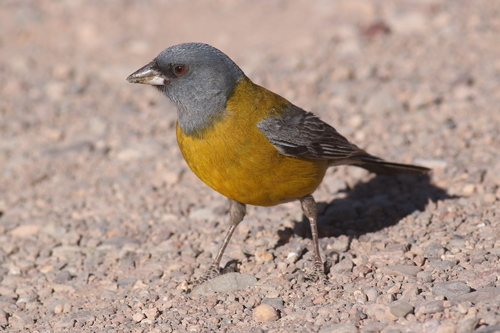
Males have a deep blue-gray hood and neck, bright yellow-gold underparts, and an olive-yellow back. Females are duller with a brownish-gray hood and greenish-yellow body.
Key Features
- Distinctive blue-gray hood covering the head and throat
- Bright yellow or golden underparts
- White vent and undertail coverts
- Pointed, dark conical bill
- Olive-tinted mantle and back
When You’ll See Them
Geographic range
Where Does the Gray-hooded Sierra-Finch Live?
This striking songbird is native to the southern cone of South America, primarily inhabiting the rugged landscapes of the Andes mountains. Its core range extends through central and southern Chile and western Argentina, stretching from high-altitude slopes down to the coastal regions in the south. While largely restricted to these two countries, its presence is a staple of the Patagonian and Andean ecosystems, where it thrives in both wild and semi-urban settings.
Basemap © OpenStreetMap contributors
Behavior
While they can be shy in the deep wilderness, these finches have adapted remarkably well to human presence in suburban and agricultural areas. They are relatively bold near mountain lodges and gardens, often approaching bird feeders or outdoor seating areas. Their flight is undulating and quick, usually staying low to the ground as they move between cover.
EverydayEarth exclusive
Camera Tips
To capture the Gray-hooded Sierra-Finch on camera, focus your efforts on ground-level placement. These birds spend the majority of their time foraging on the floor, so mounting your camera 12 to 24 inches above the ground is ideal. Angle the lens toward a flat rock or a patch of short grass. If you are in a backyard setting, placing the camera near a low-profile bird bath or a ground feeder stocked with millet and sunflower hearts will guarantee frequent visits.
Because these birds are small and move with quick, nervous hops, a fast trigger speed is essential to avoid blurry images. If your camera supports it, use a high-frame-rate video setting (60fps) to capture the fluid motion of their foraging. Positioning the camera so the morning sun is behind you will highlight the brilliant contrast between their blue-gray hoods and golden bodies, which can otherwise look muted in deep shade.
During the colder winter months, these finches often migrate to lower elevations or move into suburban valleys to find food. This is the peak time to use a camera in a garden setting. Try placing the camera near 'transition zones'—places where thick scrub meets an open lawn. The finches will often perch on a low branch to scout the area before hopping down to the ground, providing the perfect opportunity for a clear, still shot.
Similar Species
Species that look similar or are commonly confused with Gray-hooded Sierra-Finch.
Frequently Asked Questions
Record Gray-hooded Sierra-Finch at your habitat
Connect a camera to start building your own species record — AI identifies every visitor automatically.