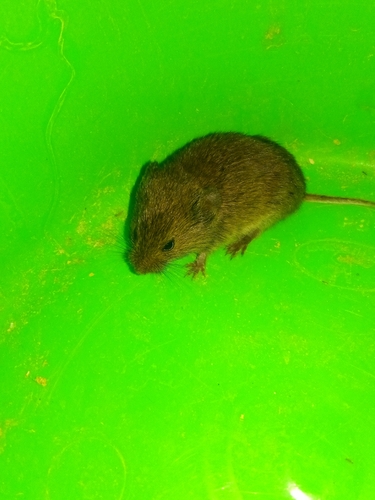
Gray-tailed Vole
Microtus canicaudus
Meet the elusive architect of the Willamette Valley. The Gray-tailed Vole is a master of camouflage and tunnel engineering, found only in a small corner of the Pacific Northwest.
Quick Identification
Size
Total length 14–16 cm (5.5–6.3 in); Weight 30–50 g (1.1–1.8 oz)
Colors
Yellowish-brown to grayish-brown upperparts; distinctly gray or silvery underparts; bicolored tail (dark gray above, light gray below)
Key Features
- Short, bicolored tail roughly 1/4 of body length
- Small, rounded ears nearly hidden in thick fur
- Stocky, mouse-like build with a blunt snout
- Soft, grayish-brown fur with silvery-gray belly
When You’ll See Them
Geographic range
Where Does the Gray-tailed Vole Live?
This specialized rodent is a true Pacific Northwest endemic, found nowhere else on Earth. Its native range is confined to the fertile Willamette Valley in western Oregon and extends slightly north across the Columbia River into Clark County, Washington. Within this small geographic footprint, they thrive in open prairie habitats and modern agricultural lands that mirror their historical grassland homes.
Basemap © OpenStreetMap contributors
Behavior
The Gray-tailed Vole is a secretive architect of the Pacific Northwest grasslands. These rodents are primarily known for constructing elaborate networks of surface runways and underground burrows, which they use to navigate safely away from the watchful eyes of hawks and owls. They are social creatures to an extent, often sharing tunnel systems with other burrowing species, though they remain notoriously difficult to trap or observe directly.
Vole populations are famous for their 'boom and bust' cycles, where numbers can skyrocket one year and plummet the next for reasons still being studied by biologists. In suburban and agricultural settings, they are often viewed as pests due to their efficiency at harvesting seeds and grasses, yet they play a crucial role in the ecosystem as a primary food source for many local predators, including the Great Horned Owl and the American Kestrel.
EverydayEarth exclusive
Camera Tips
Capturing the Gray-tailed Vole on camera requires a 'micro' approach. Because these rodents spend most of their lives in tunnel systems or under the cover of tall grass, you should look for 'runways'—well-worn paths about two inches wide in the thatch. Place your camera just three to five inches off the ground, angled slightly downward to focus on the runway itself rather than the horizon.
Since they are sensitive to movement and light, a camera with a 'no-glow' or 'black' infrared flash is essential to avoid spooking them during their nocturnal forays. Use a high-sensitivity trigger setting and the shortest possible trigger delay, as these voles move quickly when crossing open patches. If you aren't seeing results, try placing the camera near a 'V-junction' in their trail network where activity is highest.
While they are active year-round, you will have the best luck in late spring and summer when vegetation provides cover but hasn't yet completely obscured the trail. For baiting, a small smear of peanut butter or a small pile of birdseed near a burrow entrance can encourage them to pause long enough for a clear photo. Ensure your camera's focal length is set for close-range shots if possible, as a vole just a foot away may appear blurry on standard trail cameras designed for deer.
Similar Species
Species that look similar or are commonly confused with Gray-tailed Vole.
Frequently Asked Questions
Record Gray-tailed Vole at your habitat
Connect a camera to start building your own species record — AI identifies every visitor automatically.