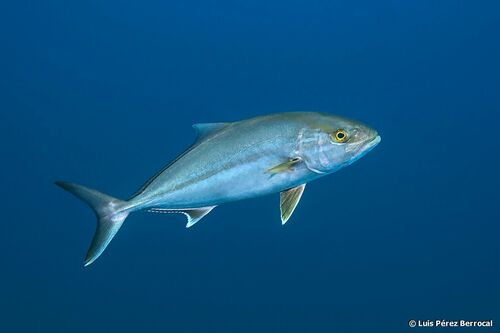
Greater Amberjack
Seriola dumerili
The powerhouse of the reef, the Greater Amberjack is a massive, silver-and-gold predator known for its incredible speed and curious nature. Whether patrolling shipwrecks or deep rocky ledges, this 'reef donkey' is a crown jewel of marine wildlife photography.
Quick Identification
Size
Typically 100-120 cm (39-47 in) in length and 18-32 kg (40-70 lbs); giants can reach 190 cm (75 in) and weigh over 80 kg (176 lbs).
Colors
Silvery-blue to olivaceous-green on the back with silver-white sides and belly; features a distinctive dark nuchal bar from the eye to the dorsal fin and often a subtle amber-gold stripe along the flank.
Key Features
- Dark diagonal nuchal band sloping from the eye to the first dorsal fin
- Deep, streamlined body with a silvery-purple sheen
- Large, deeply forked caudal fin (tail) with a powerful base
- Second dorsal fin is significantly longer than the first
When You’ll See Them
Geographic range
Where Does the Greater Amberjack Live?
The Greater Amberjack is a truly global species, inhabiting the subtropical and tropical reaches of the Atlantic, Pacific, and Indian Oceans. In the Western Atlantic, they range from the rugged coasts of Nova Scotia down to the warm waters of Brazil, including the entirety of the Gulf of Mexico. They are also a staple of the Mediterranean Sea and are widely distributed across the Indo-Pacific from South Africa and Japan to the shores of Australia and Hawaii.
Basemap © OpenStreetMap contributors
Behavior
The Greater Amberjack is a formidable predator, often called the 'reef donkey' by those who encounter them due to their immense strength and stubbornness. They are highly curious and social fish, typically forming small to medium-sized schools around high-relief underwater structures. Unlike many shy marine species, Greater Amberjacks are known to approach divers and underwater cameras, often circling to investigate unfamiliar objects in their territory.
These fish are opportunistic hunters that use their speed and power to overwhelm prey. They are most active during the day but are known to hunt effectively at night near artificial light sources or under a full moon. Younger individuals are often found in shallower waters near floating debris or sargassum mats, while larger, mature adults prefer the deep edges of reefs and shipwrecks.
EverydayEarth exclusive
Camera Tips
Capturing the Greater Amberjack on an underwater trail camera requires a focus on 'structure.' These fish are magnetically attracted to vertical relief, so mounting your camera near reef edges, dock pilings, or submerged wreckage is essential. For the best results, aim the lens horizontally across the top of the structure, as amberjacks often hover just above the highest point of a reef to scout for prey.
Lighting is a major factor in marine videography. Because Greater Amberjacks are most active during the dawn and dusk 'transition' periods, use a camera with high dynamic range or a sensor optimized for low light. If using artificial lights, avoid pointing them directly forward, as the silver scales of the fish can cause a 'white-out' effect; instead, angle lights from the side to highlight their golden-amber lateral stripe and dark eye bands.
To attract these curious predators to your lens, movement is more effective than scent. A spinning, reflective lure or a 'flasher' suspended in the water column can pull them in from a distance. Set your AI-powered camera to a high frame rate—at least 60 frames per second—to capture their lightning-fast strikes and powerful swimming motions without blur. Ensure your housing is rated for at least 30 meters if you are targeting the larger, offshore adults.
Similar Species
Species that look similar or are commonly confused with Greater Amberjack.
Frequently Asked Questions
Record Greater Amberjack at your habitat
Connect a camera to start building your own species record — AI identifies every visitor automatically.