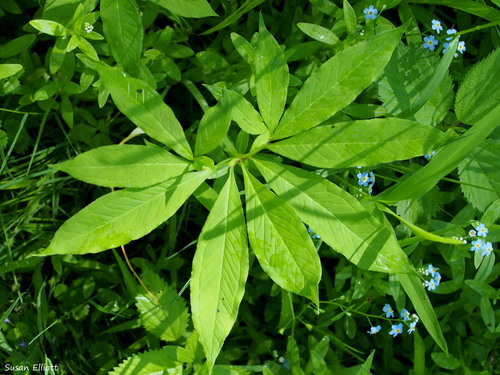
green dragon
Arisaema dracontium
A hidden gem of the North American understory, the Green Dragon features a whip-like 'tongue' and a striking crown of leaflets. It spends the spring in emerald camouflage before erupting into a brilliant spire of flame-colored berries in the fall.
Quick Identification
Size
Height 20–100 cm (8–40 in); leaf width 20–30 cm (8–12 in)
Colors
Solid deep green foliage; pale green flowering hood; bright orange-red berry clusters in autumn
Key Features
- Single large, horseshoe-shaped leaf with 7-13 narrow leaflets
- Long, tapering spadix ('dragon's tongue') extending 5-15 cm beyond the hood
- Green, tubular spathe (hood) at the base of the spike
- Compact vertical cluster of berries that turn from green to scarlet
- Central leaflet is significantly larger than the side leaflets
When You’ll See Them
Geographic range
Where Does the green dragon Live?
The Green Dragon is a distinctive resident of North America, claiming a broad territory that stretches from the southern edges of Quebec and Ontario down through the eastern United States. Its range extends as far west as the Great Plains of Texas and Nebraska, and reaches south into the humid woodlands of Florida and northeastern Mexico. While it is widely distributed across the American Midwest and South, it remains a rare and protected sight in its northernmost Canadian reaches.
Basemap © OpenStreetMap contributors
Behavior
The Green Dragon is a master of seasonal timing and deceptive allure. Emerging in late spring, it produces a single, architecturally complex leaf that sits horizontally like a tropical umbrella. Unlike its relative, the Jack-in-the-Pulpit, the Green Dragon sends its long, slender spadix—the 'dragon’s tongue'—soaring upward and outward, far past the protective green hood. This tongue serves a specific purpose: it emits a faint scent that mimics fungi, tricking fungus gnats and small flies into entering the flower for pollination.
As the summer heat intensifies, the flowering parts wither, and the plant focuses its energy on a dense head of berries. These berries remain camouflaged in green for months, hidden beneath the large leaf. By late August or September, the foliage begins to yellow and die back, revealing a spectacular transformation as the berries ripen into a brilliant, waxy orange-red. This is a survival strategy, signaling to ground-foraging birds and small mammals that a high-energy meal is ready just as they begin preparing for winter.
EverydayEarth exclusive
Camera Tips
Capturing the Green Dragon on a trail camera requires a 'macro' mindset. To document the fascinating flowering stage, set your camera on a low tripod or a ground mount just 12-18 inches off the forest floor. Angle the lens slightly upward to catch the 'dragon’s tongue' (the spadix) as it emerges from the green hood. Because these plants grow in deep shade, ensure your camera has a high-quality sensor that handles low-light well without blowing out the greens.
The most rewarding way to use AI-powered cameras with this species is via time-lapse mode. Set your camera to take one photo every 2-4 hours during the month of May. When played back, you can see the single leaf unfurl like an opening hand—a process that looks remarkably alien and fluid. In the late summer, move your camera to capture the color shift of the berries from green to red; this transition usually happens over a period of two weeks in late August.
If you are interested in the 'wildlife' aspect of this plant, focus your camera on the berry cluster in September. The bright red color is a magnet for wood thrushes, wild turkeys, and even some woodland rodents. Use a 'Hybrid' mode (photo followed by short video) triggered by motion. This will help you catch the exact moment a bird discovers the berries, providing a rare look at how this plant disperses its seeds through the local ecosystem.
Similar Species
Species that look similar or are commonly confused with green dragon.
Jack-in-the-Pulpit
Jack-in-the-pulpit has only three leaflets per leaf and a shorter spadix that stays hidden under a striped purple or green hood.
Virginia Creeper
Though it also has compound leaves, Virginia Creeper is a climbing vine with five leaflets, whereas the Green Dragon is a free-standing herb with 7-13 leaflets.
Frequently Asked Questions
Record green dragon at your habitat
Connect a camera to start building your own species record — AI identifies every visitor automatically.