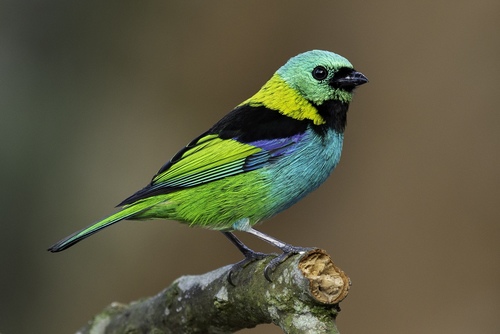
Green-headed Tanager
Tangara seledon
Meet the Atlantic Forest's most colorful resident. With a palette of neon green, turquoise, and fire-orange, the Green-headed Tanager is a backyard birding masterpiece.
Quick Identification
Size
Length of 13.5 cm (approx. 5.3 inches); weight ranges from 18 to 22 grams (0.6-0.8 oz).
Colors
Explosion of color including a neon-green head, turquoise-blue neck and throat, black back and bib, vibrant orange-red rump, and lime-green wings.
Key Features
- Electric green head contrasting with a black 'bib' on the chest
- Vibrant orange-red lower back and rump visible in flight
- Turquoise-blue collar and throat area
- Short, stout black beak perfect for fruit-eating
When You’ll See Them
Geographic range
Where Does the Green-headed Tanager Live?
Native to the lush South American continent, the Green-headed Tanager is a jewel of the Atlantic Forest biome. Its core range spans the coastal regions of south-eastern Brazil, extending inland to far eastern Paraguay and the north-eastern tip of Argentina. While it is a specialist of the humid forest, it has adapted well to the wooded fringes of urban centers like Rio de Janeiro and São Paulo, provided there is enough canopy cover and native vegetation.
Basemap © OpenStreetMap contributors
Behavior
The Green-headed Tanager is a highly social and energetic bird, often seen moving through the canopy in boisterous mixed-species flocks. They are rarely found alone, preferring the company of other tanagers and honeycreepers as they traverse the Atlantic Forest in search of food. Their movement is characterized by quick, acrobatic hops along branches, frequently hanging upside down to reach ripe fruit or to glean small insects from the undersides of leaves.
In areas where humans have preserved native fruiting trees, these birds become surprisingly bold. They are frequent visitors to backyard bird feeders in coastal Brazil, often arriving in small family groups. While they aren't known for a complex song, their constant high-pitched 'seep' calls keep the flock together as they move through the dense foliage. They are non-migratory, remaining in their colorful territories year-round.
EverydayEarth exclusive
Camera Tips
To capture the stunning iridescence of the Green-headed Tanager, position your AI camera near high-elevation fruit feeders or naturally fruiting trees like figs or guavas. These birds prefer to stay mid-to-high in the canopy, so mounting your camera on a second-story balcony or using a high-pole mount facing a well-lit branch will yield the best results. Angle the camera slightly downward to catch the brilliant orange-red rump, which is one of their most striking features.
Baiting is highly effective for this species. They are particularly fond of halved bananas and papayas. Place the fruit on a flat platform feeder or skewer it onto a branch in clear view of the camera lens. Because they often travel in groups, set your camera to take rapid-fire bursts or short video clips; this increases your chances of capturing social interactions and the beautiful wing patterns that are lost in a single still shot.
Lighting is critical for this species. Because their feathers are structural and iridescent, they look best in bright, indirect morning light. Avoid deep shade, which can make their vibrant greens and blues look dark or black. Set your camera's trigger sensitivity to 'High,' as these birds are fast movers and rarely sit still for more than a few seconds. If your camera supports it, use a fast shutter speed to freeze their frantic hopping movements.
Similar Species
Species that look similar or are commonly confused with Green-headed Tanager.
Seven-colored Tanager
The Seven-colored Tanager has a turquoise crown and a distinct yellow patch on the lower back, whereas the Green-headed has a neon-green head and orange rump.
Gilt-edged Tanager
Lacks the turquoise neck and black bib; the Gilt-edged is primarily yellow and green with a black mask around the eyes.
Frequently Asked Questions
Record Green-headed Tanager at your habitat
Connect a camera to start building your own species record — AI identifies every visitor automatically.