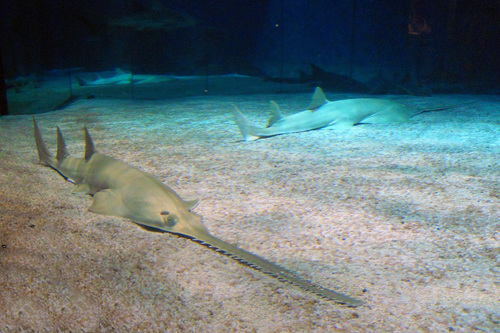
Green Sawfish
Pristis zijsron
A prehistoric marvel of the tropical shallows, the Green Sawfish is a master of the silty seafloor. Recognized by its massive, tooth-lined rostrum, this critically endangered giant is one of the ocean's most elusive and awe-inspiring sights.
Quick Identification
Size
Maximum length of up to 7.3 metres (24 feet), though modern sightings typically range from 3-5 metres (10-16 feet) with weights up to 600kg (1,320 lbs)
Colors
Dull olive-green or yellowish-brown on the upper body with a sharply defined white or pale cream underbelly
Key Features
- Extremely long rostrum (saw) with 23-34 pairs of evenly spaced teeth
- Pectoral fins originate well behind the start of the first dorsal fin
- Shark-like body with a greenish-olive hue and no distinct lower tail lobe
When You’ll See Them
Geographic range
Where Does the Green Sawfish Live?
The Green Sawfish is native to the warm waters of the Indo-West Pacific, though its historical range has contracted significantly. Today, Northern Australia serves as the species' primary global stronghold, offering the vast, undisturbed coastal habitats they require. Beyond Australia, small and fragmented populations may still persist in parts of Southeast Asia, Indonesia, and Papua New Guinea, though they are now tragically extinct in much of their former range along the East African coast and the Red Sea.
Basemap © OpenStreetMap contributors
Behavior
The Green Sawfish is a specialized bottom-dweller that moves with a deceptive, slow-motion grace through silty coastal waters. It uses its iconic rostrum as both a high-tech sensory array and a brutal hunting tool. Thousands of tiny electro-receptors along the snout allow the sawfish to detect the faint electrical pulses of prey hidden beneath the sand, making it an effective hunter even in pitch-black or murky water.
When a Green Sawfish locates a school of fish, it thrashes its saw in a rapid side-to-side motion, impaling or stunning multiple targets at once. Despite their formidable appearance and massive size, they are generally non-aggressive toward humans unless provoked or accidentally stepped on in the shallows. They are largely solitary creatures, though they exhibit a strong 'homing' instinct, returning to specific estuaries for nursery periods.
EverydayEarth exclusive
Camera Tips
Capturing a Green Sawfish requires a specialized underwater or 'pier-cam' setup. Because they are shy and inhabit murky, tidal areas, your camera needs to be housed in a rugged, waterproof casing and weighted heavily to withstand coastal currents. For the best results, mount your camera on a submerged structure like a dock piling or a custom seafloor tripod in a known travel corridor, such as a narrow channel within a mangrove system or an estuarine bottleneck.
Attracting these predators is most effective through scent rather than visual lures. Secure a perforated bait box containing oily fish—like mullet or mackerel—about 3 to 5 feet in front of the lens. The Green Sawfish will follow the scent trail and may spend considerable time using its rostrum to investigate the bait box, providing you with incredible close-up footage of their unique dental structure and sensory pores.
Visibility is often the biggest hurdle in sawfish photography. Standard white lights can cause significant 'backscatter' (reflecting off particles in the water) and may spook the fish. Instead, utilize high-powered infrared (IR) illumination for nighttime recording. This allows you to capture clear, natural behavior without disturbing the animal. Setting your camera to record 60fps video is preferable to still photos, as the rapid thrashing of the saw can be analyzed frame-by-frame for scientific identification.
Always be mindful of the tide; the best footage is often captured during the 'flood tide' when sawfish move into shallow flats to forage. Ensure your equipment is tethered with marine-grade stainless steel cables, as a curious sawfish can easily snag a camera with its rostrum and drag it a considerable distance. Finally, always check local marine sanctuary regulations before deploying any monitoring equipment for this protected species.
Similar Species
Species that look similar or are commonly confused with Green Sawfish.
Frequently Asked Questions
Record Green Sawfish at your habitat
Connect a camera to start building your own species record — AI identifies every visitor automatically.