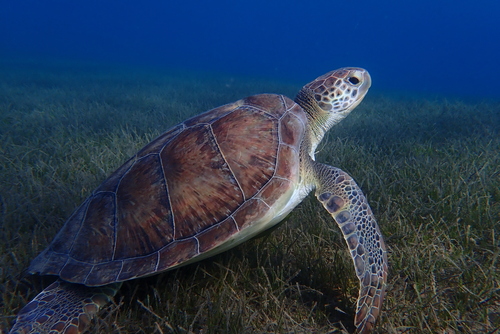
Green Sea Turtle
Chelonia mydas
Meet the ocean's most famous gardener. The Green Sea Turtle is a majestic marine wanderer whose diet of seagrass keeps our coastal ecosystems healthy and vibrant.
Quick Identification
Size
Carapace length of 80-120 cm (31-47 inches); weight typically ranges from 150-190 kg (330-420 lbs)
Colors
Carapace is mottled olive, brown, or black; plastron (underside) is pale yellow or cream. Adults do not show sexual dimorphism in color, though males have longer tails.
Key Features
- Single pair of prefrontal scales between eyes
- Heart-shaped, smooth carapace with four lateral scutes
- Serrated lower jaw adapted for grazing
- Large, paddle-like flippers with a single visible claw
When You’ll See Them
Sightings on EverydayEarth
Jul 31, 2026
A vibrant underwater scene in the lagoon shows a high level of activity. A Leopard Shark glides across the sandy bottom in the foreground, showing off its striking spotted pattern. In the background, a Green Sea Turtle swims slowly through the water column. Multiple Bat Rays glide gracefully through the scene, while various fish, including California Sheephead, dart around the coral-covered rock formations. Shifting shafts of sunlight filter down from the surface, illuminating the habitat.
Jul 28, 2026
A Green Sea Turtle swims gracefully across the sandy lagoon floor, passing by a Leopard Shark resting quietly on the bottom. Several smaller fish are seen darting around rocky coral structures in the background and foreground.
Jul 22, 2026
An active underwater scene where a Green Sea Turtle swims gracefully from the right side of the frame toward the surface. A Bat Ray, initially resting on the sandy bottom, begins to swim, showing its broad wings. In the background, a Leopard Shark moves slowly near the coral-like structures, while numerous smaller fish dart through the light beams filtering down from above.
Jul 21, 2026
An active underwater scene in a large aquarium lagoon. A Blacktip Reef Shark swims across the foreground, while a Zebra Shark rests motionless on the sandy floor. A Bat Ray and a Green Sea Turtle are visible swimming in the mid-background among various tropical reef fish and coral structures.
Jul 18, 2026
In a busy underwater scene, scuba divers are conducting habitat maintenance, using a vacuum tool to clean the sandy floor of the lagoon. A Blacktip Reef Shark swims through the mid-water column, while a large Green Sea Turtle remains stationary on the bottom near the cleaning activity. Small tropical fish are also scattered throughout the tank.
Jul 18, 2026
In the underwater lagoon, a Leopard Shark swims quickly across the foreground, momentarily obscuring the view. On the sandy bottom, a Zebra Shark remains stationary near a rock formation, while a Green Sea Turtle rests on the right before slowly adjusting its position on the sand.
Geographic range
Where Does the Green Sea Turtle Live?
The Green Sea Turtle is a truly global species, inhabiting the tropical and subtropical waters of the Atlantic, Pacific, and Indian Oceans. They are native to the coastlines of over 140 countries, with significant populations centered around the Caribbean, the Great Barrier Reef in Australia, and the Hawaiian archipelago. While they roam the open ocean as juveniles, adults remain primarily within the coastal zones of equatorial regions.
Basemap © OpenStreetMap contributors
Behavior
Green sea turtles are the world's great maritime wanderers, known for undertaking extraordinary migrations that span thousands of miles between their feeding grounds and the specific natal beaches where they return to nest. While they spend most of their time submerged, they are air-breathers that must surface every few minutes when active, though they can stay underwater for several hours while resting or sleeping.
These turtles are generally solitary but can be found in large numbers in areas with abundant seagrass or during the nesting season. They are remarkably graceful in the water, using their powerful front flippers to 'fly' through the marine environment. While they are often wary of humans, they have become a staple of ecotourism in areas where they have grown accustomed to snorkelers and divers.
EverydayEarth exclusive
Camera Tips
Capturing Green Sea Turtles on a trail camera requires a coastal setup, specifically targeting nesting beaches or tidal flats. If you are monitoring a nesting beach, place your camera on a low stake (about 12-18 inches high) near the vegetation line where turtles are likely to dig their nests. Angle the camera slightly upward to catch the turtle's face and the high-arching shell. Because these animals are highly sensitive to light, it is critical to use 'No-Glow' or 'Black' infrared flash settings; a standard white flash or even a visible red glow can cause a nesting female to abandon her eggs and return to the sea.
Timing is everything when filming on the beach. Set your camera to burst mode or short video clips (15-30 seconds) during the night hours of the nesting season. Look for 'crawls'—distinctive tracks in the sand that look like heavy tire treads—to identify high-traffic paths. If you are hoping to capture hatchlings, monitor the nest site approximately 45 to 60 days after the eggs were laid, focusing the camera on the depression in the sand where the 'boil' of emerging turtles will occur.
For those with access to saltwater docks or backyard canals in tropical regions, consider mounting a camera overlooking a known seagrass patch during high tide. Green Sea Turtles are creatures of habit and often return to the same grazing spots daily. Using a polarized filter on your camera lens can help reduce water surface glare, allowing you to see the turtle's shell more clearly as it surfaces for air or grazes in the shallows.
Frequently Asked Questions
Record Green Sea Turtle at your habitat
Connect a camera to start building your own species record — AI identifies every visitor automatically.