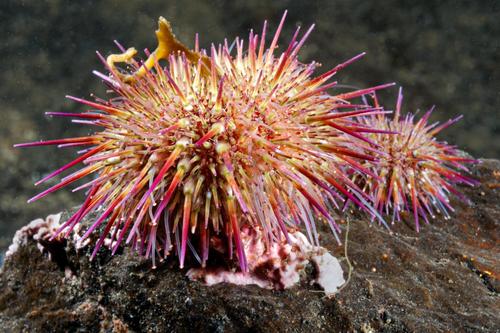
Green Sea Urchin
Psammechinus miliaris
The Green Sea Urchin is a master of the rocky shoreline, known for wearing shells as hats and grazing through tide pools with its five-toothed mouth. A resilient inhabitant of the North Sea, it is a tiny but vital engineer of the underwater world.
Quick Identification
Size
Diameter of 3.5-5 cm (1.4-2 inches); spines are relatively short and dense.
Colors
Dull greenish or greenish-brown test (shell); spines are pale green with distinct purple or reddish tips.
Key Features
- Globular shape with five-fold symmetry
- Short, dense spines with purple tips
- Tube feet visible between spines
- Commonly 'decorated' with bits of shell or algae
When You’ll See Them
Geographic range
Where Does the Green Sea Urchin Live?
Native to the eastern Atlantic Ocean and the North Sea, the Green Sea Urchin is a common sight along the temperate coastlines of Europe. Its core range extends from the northern reaches of Scandinavia and Iceland down through the British Isles and France to the northern coast of Morocco. It is particularly abundant in the rocky intertidal zones of the United Kingdom, Ireland, and the Azores, where it thrives in sheltered bays and estuaries.
Basemap © OpenStreetMap contributors
Behavior
The Green Sea Urchin is a fascinating creature of the intertidal zone, best known for its 'covering behavior.' It uses its specialized tube feet to pick up small stones, empty shells, and fragments of seaweed, which it holds against its body. This acts as a form of camouflage against predators like crabs and gulls, and also serves as a biological sunscreen, protecting its delicate tissues from intense UV radiation during low tide.
While they appear stationary to the casual observer, these urchins are surprisingly mobile. They move using a combination of their movable spines, which act like stilts, and their hydraulic tube feet, which provide suction for climbing vertical rock faces. They are primarily nocturnal or active during high tide, emerging from rocky crevices to graze on the seafloor when they feel most secure from desiccation and predation.
EverydayEarth exclusive
Camera Tips
Capturing the Green Sea Urchin requires a waterproof setup, ideally an action camera or a submersible trail camera capable of time-lapse photography. Because these creatures move very slowly, a standard video might look like a still photo; instead, set your camera to take one high-resolution image every 30 to 60 seconds. When played back as a video, this will reveal the urchin's surprisingly active lifestyle, showing how it rotates its spines and adjusts its shell camouflage.
Position your camera in a stable tide pool that doesn't completely dry out at low tide. Use a weighted base or a heavy diving weight to secure the camera against the surge of the waves. Aim the lens toward a rocky surface covered in short green or red algae, as this is where the urchins are most likely to spend their time grazing. Ensuring the camera is at a slight upward angle can help capture the movement of the tube feet underneath the spines.
Lighting is the biggest challenge underwater. If you are filming in shallow tide pools, midday sun provides the best natural light, but be wary of the camera's own shadow, which might cause the urchin to point its spines toward the 'threat.' If using a camera with built-in LEDs for night shots, the Green Sea Urchin's purple-tipped spines will often reflect the light beautifully, creating a striking contrast against the dark sea floor.
To attract an urchin into the frame, you can place a small piece of fresh kelp or a crushed mussel directly in front of the lens. These urchins have a keen sense of 'smell' (chemoreception) and will slowly gravitate toward the food source. This is the best way to get a close-up look at their Aristotle's lantern—the five-toothed structure they use to grind down their food.
Frequently Asked Questions
Record Green Sea Urchin at your habitat
Connect a camera to start building your own species record — AI identifies every visitor automatically.