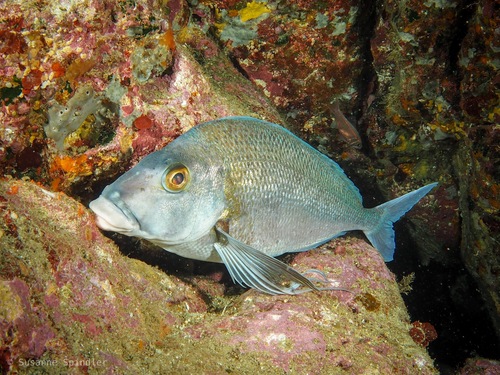
Grey Morwong
Nemadactylus douglasii
A shimmering icon of the Southwestern Pacific, the Grey Morwong is a master of the reef-sand interface. With its distinctive rubbery lips and elegant elongated fins, this inquisitive fish is a star of underwater coastal photography.
Quick Identification
Size
Grows up to 70–80 cm (28–31 inches) in length; typically weighs between 2 and 5 kg (4.4–11 lbs).
Colors
Uniform silvery-grey to iridescent blue-grey on the upper body, transitioning to a bright silver or white underbelly; fins often have a translucent greyish hue.
Key Features
- Distinctively thick, fleshy 'rubber' lips
- Greatly elongated lower ray of the pectoral fin
- Deeply compressed, oval-shaped body with a silver-blue sheen
When You’ll See Them
Geographic range
Where Does the Grey Morwong Live?
The Grey Morwong is native to the temperate and subtropical waters of the Southwestern Pacific Ocean. Its core population is concentrated along the southeastern coast of Australia, ranging from southern Queensland down through New South Wales to eastern Tasmania. It is also a prominent species in New Zealand, specifically along the northeastern coast of the North Island, where it is frequently referred to as the Porae.
Basemap © OpenStreetMap contributors
Behavior
The Grey Morwong is a calm and social marine species, often found in small groups or pairs patrolling the transition zones between rocky reefs and open sand. They are known as 'suction feeders,' using their specialized, thick lips to vacuum up mouthfuls of sediment. They then expertly sift through the grit to extract small invertebrates before expelling the unwanted sand through their gill covers.
While they are relatively bold and often approach divers out of curiosity, they remain alert to predators. During the day, they are quite active, hovering just centimeters above the sea floor. At night, they tend to settle into more sheltered areas of the reef to rest. They do not hold strict territories but generally stay within a preferred local reef system for long periods.
EverydayEarth exclusive
Camera Tips
Capturing the Grey Morwong requires a waterproof setup, such as an underwater action camera (like a GoPro) or a specialized marine trail camera. To get the best results, mount your camera to a weighted base or a small tripod and place it on a flat, sandy patch immediately adjacent to a rocky reef edge. This 'edge' habitat is their primary corridor for movement and foraging. Aim the camera horizontally or at a slight 10-degree upward tilt to capture the iridescent blue shimmer of their scales as they catch the sunlight filtering from above.
To guarantee an appearance on camera, use a scent-based attractant. A mesh 'burley' bag filled with crushed pilchards, chopped squid, or prawn shells is highly effective. Secure the bait bag roughly 1 to 2 meters in front of the lens. The Grey Morwong’s keen sense of smell will lead it to the site, and you’ll likely capture fascinating footage of its unique 'vacuum' feeding behavior as it investigates the area around the bait.
Timing is critical for lighting; the two hours after sunrise and the two hours before sunset provide the most dramatic underwater lighting, often creating beautiful 'God rays' that enhance the silver-blue color of the fish. If your camera allows, set it to record in 60fps or higher. This enables you to review the footage in slow motion, which is the best way to observe the delicate movement of their elongated pectoral fin rays—a feature they use like feelers to sense the terrain.
Ensure your camera is perfectly stationary; these fish are remarkably observant and may be deterred by a camera that is swaying in the current. If you live near a jetty or have a private dock in a saltwater canal or bay, lowering a camera on a pole to the seabed during an incoming tide is an excellent 'backyard' method for spotting this species without needing to dive.
Similar Species
Species that look similar or are commonly confused with Grey Morwong.
Frequently Asked Questions
Record Grey Morwong at your habitat
Connect a camera to start building your own species record — AI identifies every visitor automatically.