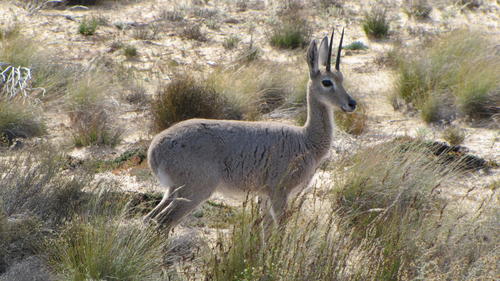
Grey Rhebok
Pelea capreolus
Known as the 'Ghost of the Mountain,' the Grey Rhebok is a woolly, silver-coated antelope that thrives in the rugged heights of Southern Africa. With its needle-sharp horns and watchful stance, this 'little goat' is a master of the high-altitude landscape.
Quick Identification
Size
Height 70–80 cm (28–31 in) at the shoulder; weight 18–30 kg (40–66 lbs).
Colors
Uniform ash-grey woolly coat with a white underbelly and white underside of the tail. Males have vertical, spike-like horns.
Key Features
- Dense, woolly grey fur texture
- Long, narrow ears with rounded tips
- Males have straight, needle-like horns 15-25 cm long
- White underside of tail visible when running
- Distinctive 'rocking-horse' bounding gait
When You’ll See Them
Geographic range
Where Does the Grey Rhebok Live?
The Grey Rhebok is a regional specialist found exclusively in the southern tip of Africa. It is native to the high-country landscapes of South Africa, Lesotho, and Eswatini. While its core population thrives in the Drakensberg Mountains and the Cape Fold Belt, it can also be spotted in the rolling hills of the Highveld and the coastal shrublands of the Western Cape.
Basemap © OpenStreetMap contributors
Behavior
Grey Rhebok are highly social and territorial animals, typically living in family groups of 8 to 15 individuals, consisting of a dominant male, several females, and their offspring. They are famous for being extremely shy and alert; at the first sign of danger, the dominant male will give a sharp, whistling snort to alert the herd. They then retreat into rugged, uphill terrain using a distinctive 'rocking-horse' gait, where they kick their hind legs up and flash the bright white underside of their tails as a visual alarm.
Unlike many other African antelope, the Grey Rhebok is exceptionally hardy and can thrive in cold, high-altitude environments. They are fiercely territorial, and males have been known to be aggressive toward other species and even domestic livestock if they feel their space is encroached upon. They are largely independent of standing water, obtaining most of the moisture they need from the plants they eat, which allows them to stay high on mountain ridges where predators are few.
EverydayEarth exclusive
Camera Tips
To capture the elusive Grey Rhebok on camera, focus on 'saddle' points—the lower dips between two mountain ridges—or well-established game trails that lead to rocky outcrops. These animals prefer areas with high visibility where they can spot predators from afar, so avoid placing your camera in thick, tall brush. Set the camera at about knee height (60 cm) to get a clear profile shot of their woolly coat and slender legs.
Because they are most active during the 'golden hours' of dawn and dusk, use a camera with a high-quality sensor and 'No-Glow' infrared flash. Standard white flashes or red-glow IR can spook this wary species, causing the herd to abandon the area for days. If you are setting up on a private property, a mineral block or salt lick placed in an open area can act as a great lure, as they often seek out minerals in their rocky environments.
In terms of settings, use a fast trigger speed and a multi-shot burst mode. When a Grey Rhebok moves, it often does so in quick, bouncy leaps; a single photo might only catch a blur or a tail. A 10-to-20 second video clip is even better, as it allows you to see the characteristic 'rocking' motion and the long, twitching ears that are their trademark.
Similar Species
Species that look similar or are commonly confused with Grey Rhebok.
Frequently Asked Questions
Record Grey Rhebok at your habitat
Connect a camera to start building your own species record — AI identifies every visitor automatically.