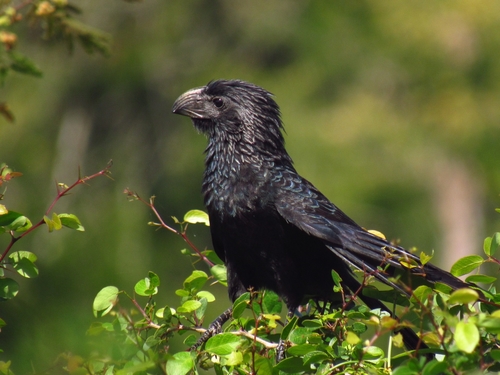
Groove-billed Ani
Crotophaga sulcirostris
Meet the socialite of the scrubland. With its oversized grooved beak and cooperative family lifestyle, the Groove-billed Ani is a charismatic visitor to tropical backyards from Texas to Peru.
Quick Identification
Size
Length: 30-34 cm (12-13.5 in); Wingspan: 43-46 cm (17-18 in); Weight: 70-90 g (2.5-3.2 oz)
Colors
Uniformly black plumage with a dull metallic sheen; black bill with distinct horizontal ridges; dark brown or black eyes
Key Features
- Massive, highly arched black bill with horizontal grooves
- Exceptionally long, rounded tail nearly half the bird's length
- Social behavior, almost always seen in groups
- Clumsy, weak-looking flight with short glides
When You’ll See Them
Geographic range
Where Does the Groove-billed Ani Live?
Native to the Americas, the Groove-billed Ani is a quintessential bird of the tropical lowlands. Its range begins in the southern tip of Texas and extends south through both coasts of Mexico and across the entirety of Central America. In South America, it occupies the Caribbean and Pacific coastal regions, stretching through Colombia and Venezuela down into Ecuador and Peru. While they are mostly year-round residents, those at the northernmost fringes may move further south during particularly cold winters.
Basemap © OpenStreetMap contributors
Behavior
The Groove-billed Ani is a fascinatingly social member of the cuckoo family, almost never seen alone. They live in tight-knit communal groups ranging from a single pair to five or more breeding pairs. These groups are famous for their cooperative breeding habits, where all females in the group lay their eggs in one large shared nest, and every adult takes turns incubating the eggs and feeding the chicks. This 'it takes a village' approach makes them one of the most unique social structures in the bird world.
In the field or backyard, they are often seen following cattle, horses, or even lawnmowers to snatch up insects flushed from the grass. They are not strong flyers, moving with a series of quick, stiff-winged flaps followed by a glide that often looks like they are struggling to keep their heavy tails and bills level. They are quite vocal, frequently communicating with a high-pitched, metallic 'tee-ho' call that helps the group stay together in dense brush.
EverydayEarth exclusive
Camera Tips
To capture the Groove-billed Ani on your backyard camera, focus your efforts on low-to-mid-level perches. These birds love dense, thorny thickets and brush piles where they feel safe from predators. Place your camera at a height of about 3 to 5 feet, aimed at a horizontal branch or the edge of a brushy area. Because they are social, where you see one, you will likely see five; use a 'Video' or 'Time-Lapse' mode to capture the charming 'follow-the-leader' behavior as the group moves through your yard.
While they don't typically visit seed feeders, they are highly attracted to water. A ground-level birdbath or a low-profile dripping water feature is an excellent lure. Position your camera to capture the water source from about 6 feet away. Morning is the best time for photography, as Anis often spend the first few hours of daylight sunning themselves with their wings spread wide to dry off the dew—a behavior that provides stunning, still shots of their iridescent feathers.
If your camera allows for exposure adjustments, consider bumping it up slightly (+0.3 or +0.7). Their deep black plumage can often trick camera sensors into underexposing, turning the bird into a featureless silhouette. By adjusting the exposure or placing the camera so the bird is illuminated by soft, morning side-lighting, you'll be more likely to capture the fine details of the horizontal grooves on their distinctive bills.
Similar Species
Species that look similar or are commonly confused with Groove-billed Ani.
Frequently Asked Questions
Record Groove-billed Ani at your habitat
Connect a camera to start building your own species record — AI identifies every visitor automatically.