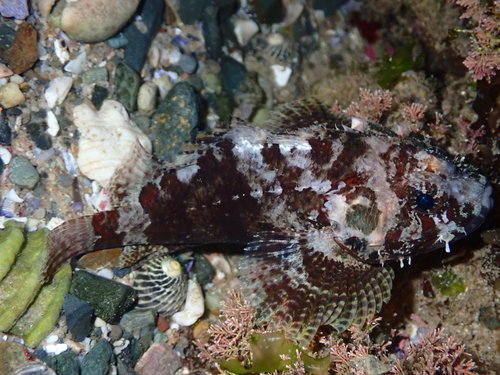
Guam Scorpionfish
Scorpaenodes guamensis
A phantom of the reef, the Guam Scorpionfish blends into the coral with uncanny precision. This nocturnal specialist is a master of the 'sit-and-wait' hunt, hiding in plain sight across the Indo-Pacific.
Quick Identification
Size
Small and stout, typically reaching 8-14 cm (3-5.5 inches) in length.
Colors
Mottled reddish-brown, tan, and white patterns; distinctive dark black spot on the gill cover (sub-operculum).
Key Features
- Distinctive dark spot on the lower gill cover
- Mottled reddish-brown camouflage patterns
- 13 venomous dorsal spines
- Large, fan-like pectoral fins used for 'walking' along the bottom
When You’ll See Them
Geographic range
Where Does the Guam Scorpionfish Live?
The Guam Scorpionfish is a quintessential resident of the Indo-Pacific, boasting a massive native range that spans from the Red Sea and the eastern coast of Africa all the way to the Tuamotu Islands in French Polynesia. It is a common sight across the tropical waters of Australia, Indonesia, and the Philippines, reaching its northernmost limits around the southern islands of Japan. While widely distributed across the Pacific islands like Guam and Fiji, there are currently no known significant introduced populations outside its native tropical waters.
Basemap © OpenStreetMap contributors
Behavior
The Guam Scorpionfish is a master of mimicry and patience. During daylight hours, it remains almost perfectly still, tucked away in coral crevices, under ledges, or camouflaged against rocky rubble. It relies entirely on its mottled coloration to avoid detection by predators like groupers and eels. Because they are so sedentary, they are often overlooked by divers and snorkelers even when they are directly in front of them.
As the sun sets, this species becomes a stealthy hunter. It doesn't chase its prey but instead waits for small crustaceans to wander within striking distance. Using a 'sit-and-wait' strategy, it uses its large mouth to create a vacuum, sucking in prey in a fraction of a second. While solitary by nature, they are frequently found in high densities in areas with plenty of hiding spots and a steady supply of food.
EverydayEarth exclusive
Camera Tips
Capturing the Guam Scorpionfish requires a specialized underwater camera setup, preferably one with a macro lens or a high-quality wide-angle lens capable of close-up focus. To get the best shots, place your camera on a weighted reef tripod or a sand-plate mount near coral rubble or at the entrance of small rocky caves. Aim the lens at a 45-degree angle toward the substrate, as these fish are almost always found resting directly on the bottom.
Since this species is strictly nocturnal, lighting is your most critical factor. Using a standard white flash can wash out their intricate patterns or startle the fish. Instead, utilize a red-light focus lamp or a low-intensity diffused video light to illuminate the scene without causing the fish to retreat into deeper cover. AI-powered cameras should be set to high-sensitivity motion detection, as the Guam Scorpionfish moves very little, often only shifting its pectoral fins to adjust its position.
Patience is the 'secret sauce' for this species. They are highly territorial and will often return to the exact same crevice or rock every single day. If you spot one during the day, mark the location and return with your camera gear at dusk. Position the camera about 12-18 inches away from the fish's likely resting spot. If you are using an EverydayEarth underwater housing, ensure the glass is clean and free of algae to capture the fine details of their 'hairy' cirri and the identifying dark spot on their operculum.
Similar Species
Species that look similar or are commonly confused with Guam Scorpionfish.
Frequently Asked Questions
Record Guam Scorpionfish at your habitat
Connect a camera to start building your own species record — AI identifies every visitor automatically.