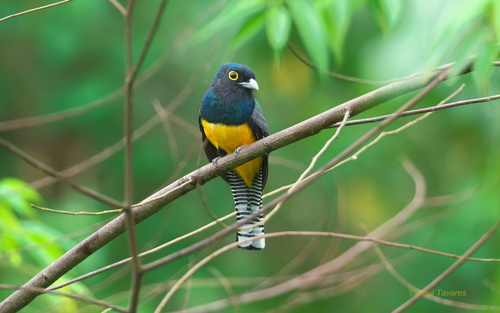
Guianan Violaceous Trogon
Trogon violaceus
Decked in shimmering violet and gold, the Guianan Violaceous Trogon is a crown jewel of the tropical canopy. A quiet observer of the forest, this stunning bird brings a touch of prehistoric elegance to the South American woodlands.
Quick Identification
Size
Length: 23–25 cm (9–10 in); Weight: 45–60 g (1.6–2.1 oz)
Colors
Males have a shimmering violet-blue head and breast with a bright yellow belly; females are slate-grey where the male is blue.
Key Features
- Shimmering violet-blue hood and chest (males)
- Bright yellow belly separated by a narrow white chest band
- Distinctive yellow eye-ring on males and white eye-crescents on females
- Underside of the tail features fine, horizontal black and white barring
When You’ll See Them
Geographic range
Where Does the Guianan Violaceous Trogon Live?
The Guianan Violaceous Trogon is a quintessential bird of the northern South American tropics. Its core range spans the lush Guiana Shield, including Guyana, Suriname, and French Guiana, and extends into eastern Venezuela and the northern Amazonian regions of Brazil. It is also a frequently spotted resident on the island of Trinidad, making it one of the most accessible trogon species for birdwatchers in the Caribbean.
Basemap © OpenStreetMap contributors
Behavior
The Guianan Violaceous Trogon is a master of the 'sit-and-wait' strategy. Known for being somewhat lethargic, these birds will perch motionless on mid-canopy branches for extended periods, scanning the surrounding foliage for movement. When they spot prey, they perform a sudden, acrobatic sallying flight to pluck an insect or fruit from a leaf before returning to a perch—often a different one than they started from.
Socially, they are usually found alone or in pairs. They are non-territorial outside of the breeding season but can be quite vocal, using a series of soft, repetitive 'cow-cow-cow' notes to communicate. One of their most fascinating behaviors is their nesting habit; they typically excavate holes in active arboreal termite mounds, where the termites' ambient heat helps incubate their eggs and the stinging insects provide a layer of protection against predators.
EverydayEarth exclusive
Camera Tips
To capture the Guianan Violaceous Trogon on camera, height is your best friend. These birds rarely descend to the ground, preferring the mid-canopy between 10 and 30 feet high. If you are using a backyard AI camera, mount it on a high pole or a second-story balcony that overlooks native fruiting trees like Ficus or Casearia. They are particularly fond of horizontal, unobstructed branches that serve as 'launching pads' for their hunting sallies.
Because trogons are sensitive to movement, place your camera in a permanent position and avoid frequent maintenance. They are most active in the early morning light when the sun first hits the canopy, illuminating their iridescent violet feathers. Setting your camera to a 'High Sensitivity' motion trigger is vital, as their initial movement from a perch is incredibly fast, though they often sit still for minutes at a time once they land.
If you have arboreal termite nests (large brown bulbous structures in trees) on your property, point your camera there. During the breeding season, trogons are highly active around these mounds as they excavate nesting cavities. Avoid using bright artificial lures; instead, planting native berry-producing shrubs will naturally draw them into the camera's field of view over time.
Similar Species
Species that look similar or are commonly confused with Guianan Violaceous Trogon.
Frequently Asked Questions
Record Guianan Violaceous Trogon at your habitat
Connect a camera to start building your own species record — AI identifies every visitor automatically.