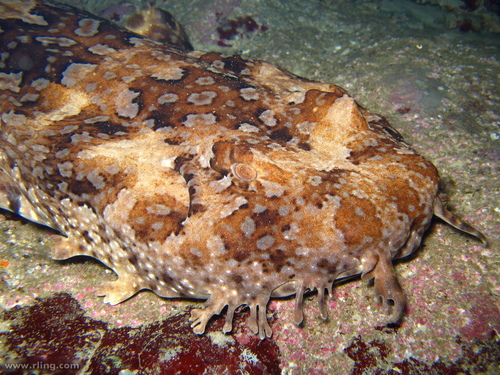
Gulf Wobbegong
Orectolobus halei
Master of the unseen, the Gulf Wobbegong is the ultimate ambush predator of Australia's southern reefs. With its ornate 'carpet' pattern and fringed tassels, it blends perfectly into the seafloor, waiting for the perfect moment to strike.
Quick Identification
Size
Typically 2.0 to 2.5 metres (6.6 to 8.2 feet), with large specimens reaching up to 2.9 metres (9.5 feet).
Colors
Mottled brown, tan, and grey camouflage with dark 'saddles' and white ring-like spots (ocelli); ventral side is pale.
Key Features
- Fleshy branching tassels (lobes) around the snout and mouth
- Broad, flattened head and body for bottom-dwelling
- Intricate 'carpet-like' camouflage pattern
- Two dorsal fins located far back on the body
When You’ll See Them
Geographic range
Where Does the Gulf Wobbegong Live?
Native exclusively to the temperate and subtropical coastal waters of Australia, the Gulf Wobbegong is a true 'Aussie' local. Its distribution spans the southern half of the continent, beginning around Southport in southern Queensland and extending southward around the coast of New South Wales, Victoria, and South Australia, all the way to Norwegian Bay in Western Australia. These sharks are highly residential, sticking closely to the continental shelf and rarely venturing into the deep open ocean.
Basemap © OpenStreetMap contributors
Behavior
The Gulf Wobbegong is a master of patient hunting, often spending its daylight hours motionless beneath rocky ledges, in caves, or tucked into seagrass beds. This species is largely nocturnal, using the cover of darkness to become a more active predator. Unlike many shark species that must keep swimming to breathe, the Wobbegong uses a buccal pumping mechanism to pull oxygenated water over its gills while remaining perfectly still on the seafloor.
While they appear sluggish and docile, they are lightning-fast ambush predators. When a prey item wanders too close to their camouflaged mouth, they expand their oropharyngeal cavity to create a powerful vacuum, sucking the prey in instantly. Socially, they are solitary, though they may be found in proximity to others where high-quality shelter is abundant. To humans, they are generally harmless unless provoked, but their defensive bite is powerful and they are known for 'hanging on' once they clamp down.
EverydayEarth exclusive
Camera Tips
Capturing a Gulf Wobbegong on camera requires an underwater setup, such as a waterproof trail camera or a stationary action camera mounted near a structure. Because they are highly residential, if you find a rocky overhang or a 'bommie' (an outcrop of coral/rock) where one is resting during the day, there is a high likelihood they will return to that exact spot. Secure your camera housing to a weighted base or a pier piling at a depth of 2 to 5 metres for the best chance of capturing shallow-water movement.
Since these sharks are nocturnal, an external light source or infrared capability is essential. Set your camera to record short video clips (15-30 seconds) rather than still photos; the Wobbegong's movement is subtle, and video helps distinguish the shark from the surrounding reef. Look for 'choke points' between rocks or gaps in seagrass where the shark might travel during its nightly foraging rounds.
Avoid placing cameras directly in the sand, as bottom surge can quickly cover the lens with silt. Instead, aim for a slightly elevated position looking down at a 45-degree angle toward the seafloor. If you are filming under a dock or pier, align the camera with the line of the pilings, as Wobbegongs often hug these structures for protection. While they aren't traditionally 'baited' like Great Whites, the scent of fresh, oily fish in a perforated container nearby can encourage them to linger in front of your lens longer than they otherwise would.
Similar Species
Species that look similar or are commonly confused with Gulf Wobbegong.
Frequently Asked Questions
Record Gulf Wobbegong at your habitat
Connect a camera to start building your own species record — AI identifies every visitor automatically.