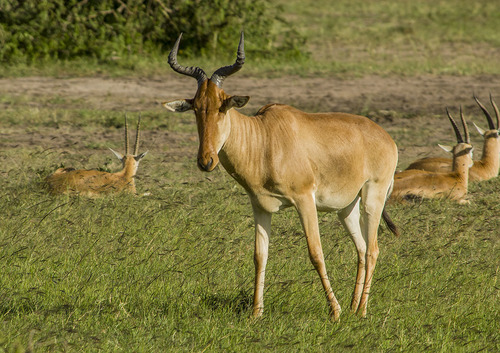
Hartebeest
Alcelaphus buselaphus
With their remarkably long faces and high-shouldered silhouettes, the Hartebeest is one of Africa’s most distinctive savanna dwellers. Known for their incredible endurance and watchful sentinels, these 'long-faced' antelopes are a masterclass in grassland survival.
Quick Identification
Size
Shoulder height of 1 m (3.3 ft); weight between 100–200 kg (220–440 lbs); head-and-body length of 2–2.5 m (6.6–8.2 ft).
Colors
Coat varies by subspecies from sandy tan to chocolate brown; often features black markings on the legs and a pale rump.
Key Features
- Extremely elongated forehead and narrow face
- Sharply sloping back from high, humped shoulders
- Double-curved, lyre-shaped horns found on both sexes
- Pointed, relatively large ears
When You’ll See Them
Geographic range
Where Does the Hartebeest Live?
The hartebeest is a quintessential African species, native to the vast grasslands and savannas of the sub-Saharan continent. Its range forms a wide arc from the semi-arid Sahel region in West Africa through Central Africa, into the highland grasslands of East Africa, and down to the scrublands of Southern Africa. While their distribution has become increasingly fragmented due to human expansion, core populations remain strong within protected national parks across countries like Kenya, Tanzania, Namibia, and South Africa.
Basemap © OpenStreetMap contributors
Behavior
Hartebeests are highly social and alert antelopes, typically found in herds ranging from a few individuals to several hundred during peak grazing seasons. They are remarkably diurnal, spending the vast majority of their daylight hours foraging and moving across the plains. One of their most distinctive social behaviors is the use of 'sentinels'; while the herd grazes, a single individual will often stand on a termite mound or elevated ground to scan for predators like lions or hyenas, snorting loudly to alert the group of danger.
These animals are also known for their impressive speed and endurance. Despite their somewhat awkward, lopsided appearance due to their sloping backs, they can reach speeds of up to 70 kph (43 mph). Territorial males are particularly sedentary, defending a specific patch of land for years, often marking their territory with dung heaps. Their interaction with humans is largely limited to game reserves and agricultural fringes, where they are sometimes viewed as competitors for livestock grazing land.
EverydayEarth exclusive
Camera Tips
When setting up a camera to capture hartebeests, the height of the lens is your most critical factor. Because of their unique sloping anatomy and extremely long faces, a camera mounted too low will often only capture their legs or the underside of their chin. Aim for a mounting height of approximately 1 to 1.2 meters (3.5 to 4 feet) and tilt the camera slightly upward. This ensures you capture the characteristic lyre-shaped horns and the distinctive elongated forehead that makes this species so photogenic.
Hartebeests are creatures of habit, particularly the territorial males. Look for 'middens' or large communal dung heaps; these are territorial markers that males visit daily to sniff and add to. Placing a camera 5-7 meters away from a midden is a guaranteed way to get clear, stationary shots of dominant males. Similarly, they are dependent on water, so positioning your gear near a permanent waterhole during the dry season will yield high-traffic results, especially during the mid-morning hours when they come to drink.
Because these antelopes live in open, often windy environments, trigger speed and false-trigger management are vital. Use a camera with a trigger speed under 0.5 seconds to catch them as they move at a steady trot. If your camera is in a field of tall grass, clear the vegetation in a 3-meter radius around the lens to prevent the wind from filling your SD card with 'ghost' triggers. Since they are most active in the golden hours of dawn and dusk, ensure your camera has a high-quality sensor that handles low-light transitions well without blowing out the highlights on their often-shiny coats.
Similar Species
Species that look similar or are commonly confused with Hartebeest.
Frequently Asked Questions
Record Hartebeest at your habitat
Connect a camera to start building your own species record — AI identifies every visitor automatically.