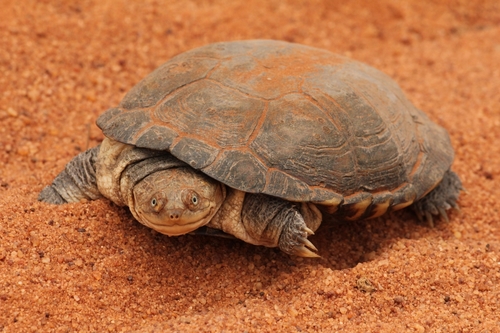
Helmeted Turtle
Pelomedusa subrufa
The African Helmeted Turtle is a prehistoric-looking survivor capable of outlasting the harshest droughts. With its unique side-folding neck and communal hunting habits, it's one of the most intriguing reptiles to visit a backyard pond.
Quick Identification
Size
Carapace length of 20-30 cm (8-12 inches); weight typically between 2-2.5 kg (4.4-5.5 lbs)
Colors
Olive, brown, or dark gray shell; yellowish or cream plastron with dark seams; gray-brown skin with fine scales
Key Features
- Head retracts sideways under the shell rim
- Five claws on each forefoot
- Smooth, flattened carapace without a hinge
- Pair of small sensory barbels under the chin
When You’ll See Them
Sightings on EverydayEarth
Jul 28, 2026
Two Helmeted Turtles are resting on a large rock in the middle of a calm body of water. They appear to be basking in the daylight, with one turtle positioned slightly higher on the rock than the other. Reeds grow along the left side of the frame, and their reflection is visible in the still water.
Jul 23, 2026
A Helmeted Turtle is perched on a sun-warmed rock in a dry, rocky area. It remains mostly still while basking, occasionally shifting its head slightly to observe its surroundings.
Jul 23, 2026
A partially submerged Common Hippopotamus rests in a waterhole during the day. Two small hitchhikers are perched on its exposed back: a Red-billed Oxpecker, which is actively moving around, and a Helmeted Turtle, which remains still while basking in the sun.
Jul 20, 2026
Two helmeted turtles are perched on a rock at the edge of the water, basking in the bright morning sunlight. One of the turtles occasionally shifts its head, while both remain mostly still to soak up the heat.
Jun 25, 2026
Two helmeted turtles are basking on sun-warmed rocks at the edge of a water source. The larger turtle holds its head high in the center of the frame, while a smaller companion remains partially submerged nearby.
Jun 25, 2026
Two Helmeted Turtles are basking on sun-warmed rocks at the edge of the water. The larger individual perches high on the rock with its neck extended, while a second turtle is partially submerged nearby.
Geographic range
Where Does the Helmeted Turtle Live?
The Helmeted Turtle boasts one of the most extensive ranges of any African reptile, stretching across the vast majority of Sub-Saharan Africa. From the southern fringes of the Sahara down to the Cape in South Africa, they are a staple of the continent's freshwater ecosystems. Beyond the mainland, they are also native to Madagascar and have established populations in the southwestern tip of the Arabian Peninsula, specifically within Yemen and Saudi Arabia, making them a truly cross-continental species.
Basemap © OpenStreetMap contributors
Behavior
The Helmeted Turtle is a master of adaptation, famous for its ability to survive in environments that fluctuate between flood and drought. Unlike most turtles that pull their heads straight back, this species belongs to the 'side-necked' group, tucking its head horizontally under the shell. They are remarkably social for reptiles and have been observed hunting cooperatively to take down larger prey like water birds or large fish, a behavior rarely seen in the chelonian world.
During the dry season, when their water sources evaporate, these turtles perform a remarkable survival feat called aestivation. They burrow deep into the mud and enter a state of dormancy that can last for months or even years until the rains return. When active, they spend significant time basking on rocks or logs to regulate their body temperature, though they remain extremely wary of predators and will dive at the slightest vibration.
EverydayEarth exclusive
Camera Tips
To capture the best footage of a Helmeted Turtle, your camera should be positioned just a few inches off the ground near a known 'hauling out' spot. Look for flat rocks or partially submerged logs that receive direct sunlight in the morning; these are prime basking locations where turtles will remain stationary for long periods, allowing for high-quality, clear captures.
Because these turtles are highly sensitive to movement, using an AI-powered camera with a fast trigger speed is essential. Angle the camera slightly downward to account for their low profile. If you are monitoring a backyard pond, place the camera at the water's edge where the slope is gentle, as this is where they typically enter and exit the water to forage for insects or lay eggs in the surrounding soil.
While they are opportunistic hunters, you can increase your chances of a close-up by using a scent-based lure. A small amount of oily fish or wet cat food placed in a perforated container near the camera can draw them in. Note that they have a keen sense of smell and will often approach the lure from downwind, so consider the prevailing breeze when setting up your gear.
Don't overlook the mud! During the transition into the dry season, keep an eye on drying pools. You might catch the fascinating sight of a Helmeted Turtle digging its way into the earth for its seasonal slumber. Set your camera to time-lapse mode if you suspect aestivation is beginning, as the process is slow but visually captivating for wildlife enthusiasts.
Similar Species
Species that look similar or are commonly confused with Helmeted Turtle.
Frequently Asked Questions
Record Helmeted Turtle at your habitat
Connect a camera to start building your own species record — AI identifies every visitor automatically.