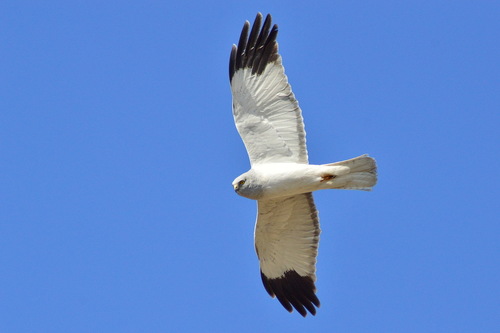
Hen Harrier
Circus cyaneus
Affectionately known as the 'Grey Ghost' in its male form, the Hen Harrier is a spectral hunter of the open plains. With its owl-like face and buoyant, low-gliding flight, it is one of the most mesmerizing birds of prey to spot on a backyard horizon.
Quick Identification
Size
Length 41–52 cm (16–20 in); Wingspan 97–118 cm (38–46 in); Weight 300–700g (10.6–24.7 oz)
Colors
Males are pale silver-grey above and white below with black wingtips; females and juveniles are brown with barred tails and a white rump.
Key Features
- Low, buoyant gliding flight with wings held in a 'V' shape
- Conspicuous white rump patch visible in both sexes
- Owlish facial disc for hunting by sound
- Males are distinctively silver-grey ('The Grey Ghost')
When You’ll See Them
Geographic range
Where Does the Hen Harrier Live?
Native to the vast expanses of Eurasia, the Hen Harrier occupies a massive range stretching from the British Isles and Western Europe through Russia to the Pacific coast of Asia. In milder regions like the United Kingdom and France, many populations are resident year-round, while those in the northern reaches of Scandinavia and Siberia migrate south to Central Asia and the Mediterranean for the winter. This raptor is a specialist of the open wild, avoiding dense forests in favor of sweeping plains and coastal wetlands.
Basemap © OpenStreetMap contributors
Behavior
The Hen Harrier is a master of low-level surveillance, known for its distinctive hunting style called 'quartering.' It flies just a few meters above the ground, methodically scanning and listening for movement in the vegetation below. Unlike many other hawks that rely solely on sight, the Hen Harrier has a facial ruff similar to an owl, which helps funnel sound into its ears to detect prey hiding in thick grass.
These birds are generally solitary during the breeding season, but they exhibit a fascinating social behavior in the winter: communal roosting. During the colder months, several harriers may gather at dusk to sleep in the same patch of marshland or tall grass. While they are wary of humans and rarely venture into dense urban centers, they are a frequent sight for those living near large, open natural spaces.
EverydayEarth exclusive
Camera Tips
Capturing a Hen Harrier on a backyard camera is a challenge unless your property borders a large field, moor, or marsh. Because they hunt by 'skimming' the ground, the best camera placement is at the edge of an open area facing toward the center of the field. Set your camera on a fence post or a dedicated stake about 3 to 5 feet off the ground, angled slightly downward to catch them as they bank or pounce on prey.
Since these birds are highly active hunters, fast trigger speeds are essential. If your camera supports it, use 'High' sensitivity settings for the PIR sensor and set the video duration to at least 20 seconds; their low-gliding flight often takes them across the frame quickly, and you’ll want to see the characteristic 'V' shape of their wings. Avoid using artificial baits, as these raptors are strictly visual and auditory hunters that prefer live, moving prey like voles.
Pay close attention to the wind direction; harriers often hunt into the wind to maintain their slow, buoyant flight. Placing your camera on the leeward side of a field where they are likely to hover or stall in the wind will increase your chances of a clear shot. During winter, look for reedbeds or tall grass patches—if you find a communal roost, placing a camera on the perimeter could capture multiple birds arriving at dusk.
Similar Species
Species that look similar or are commonly confused with Hen Harrier.
Montagu's Harrier
Montagu's are slimmer with narrower wings; males have a black bar across the secondaries which Hen Harriers lack.
Pallid Harrier
Males are much paler with smaller, wedge-shaped black wingtips; females are nearly identical but have a more distinct neck collar.
Northern Harrier
The North American counterpart; males are darker grey and females have more rufous tones on their underparts.
Frequently Asked Questions
Record Hen Harrier at your habitat
Connect a camera to start building your own species record — AI identifies every visitor automatically.