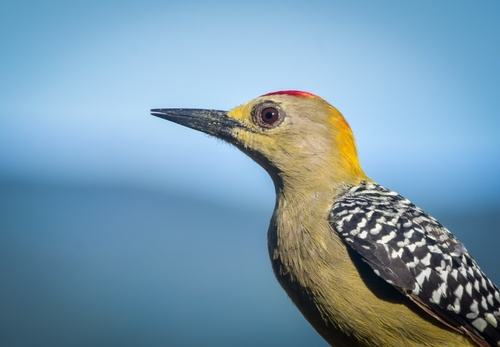
Hoffmann's Woodpecker
Melanerpes hoffmannii
A colorful and energetic resident of Central American gardens, Hoffmann's Woodpecker is as famous for its 'zebra-back' plumage as it is for its bold, social personality.
Quick Identification
Size
18 cm (7.1 in) long; wingspan approximately 33-36 cm (13-14 in); weight 62-84 g (2.2-3.0 oz)
Colors
Black and white barred back; buff-gray underparts; yellow belly patch and nape; males have a red crown patch while females have a white crown.
Key Features
- Zebra-like black and white horizontal barring on back
- Bright yellow patch on the lower belly
- Golden-yellow nape on both sexes
- Male has a distinct red cap on top of the head
When You’ll See Them
Geographic range
Where Does the Hoffmann's Woodpecker Live?
Hoffmann's Woodpecker is a quintessential Central American resident, primarily found along the Pacific slope from southern Honduras through Nicaragua and into the central highlands of Costa Rica. While originally a bird of dry and gallery forests, it has expanded its range significantly as agricultural clearing has created the open, park-like habitats it favors. It is now a common sight in urban centers like San José and Managua, flourishing anywhere there are sufficient trees for nesting and foraging.
Basemap © OpenStreetMap contributors
Behavior
Hoffmann's Woodpeckers are lively, charismatic birds that have successfully integrated into human-altered landscapes. They are highly vocal and social, often traveling in pairs or small family units while maintaining a constant chatter of rattling calls. They are famous for their 'drumming'—a rhythmic tapping on resonant dead wood used to communicate territory and attract mates, a sound that frequently echoes through Central American suburbs and farms.
These birds exhibit classic woodpecker locomotion, 'hitching' themselves up tree trunks using their stiff tail feathers for support. While they are territorial during the nesting season, they are generally tolerant of humans and can become quite bold around backyard bird feeders. Their flight is distinctly undulating, consisting of a few quick flaps followed by a short glide with wings tucked.
EverydayEarth exclusive
Camera Tips
To capture Hoffmann's Woodpecker on camera, focus your efforts on fruit. They are easily lured to 'bird tables' or hanging feeders stocked with overripe bananas, plantains, or papayas. Position your camera about 4 to 6 feet away from the feeding station at eye level with the bird to capture the intricate details of their barred plumage and the male’s red crown. Use a fast shutter speed or high-frame-rate video setting, as their movements while feeding are often quick and twitchy.
Look for 'drumming' posts—resonant, dry branches or even wooden utility poles—that the birds return to daily. Mounting a camera with a side-view angle of these locations can provide spectacular footage of their territorial displays. If you are lucky enough to have a nesting pair, aim your camera at the cavity entrance from a respectful distance of at least 15 feet. Use a telephoto lens or a high-resolution sensor that allows for cropping, as these birds are sensitive to close-range movement near their nests.
Since these woodpeckers are strictly diurnal, ensure your camera's exposure settings are optimized for high-contrast tropical light. They often forage in the 'checkered shade' of the canopy, which can trick auto-exposure sensors. If your camera allows, set a center-weighted metering mode to ensure the bird remains correctly exposed even against a bright sky. Early morning light is best, as it highlights the yellow nape and belly patches that are key for identification.
Similar Species
Species that look similar or are commonly confused with Hoffmann's Woodpecker.
Frequently Asked Questions
Record Hoffmann's Woodpecker at your habitat
Connect a camera to start building your own species record — AI identifies every visitor automatically.