Hooded Crow
Corvus cornix
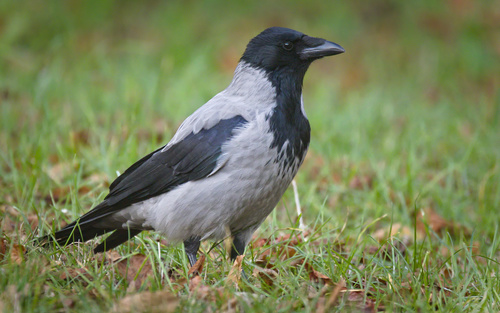
Meet the 'Hoodie,' the two-toned genius of the corvid family. With their striking grey-and-black plumage and legendary intelligence, these birds bring a touch of wild sophistication to every backyard.
Quick Identification
Size
Length 48-54 cm (19-21 in); wingspan 84-100 cm (33-39 in); weight 370-650 g (13-23 oz)
Colors
Ashy-grey body and mantle; solid black head, throat, wings, and tail; black bill and legs
Key Features
- Distinctive grey torso contrasting with a black 'hood' and bib
- Heavy, slightly curved black beak
- Broad, rounded wings with visible 'fingers' in flight
- Social and vocal with a characteristic 'kraa-kraa' call
When You’ll See Them
Geographic range
Where Does the Hooded Crow Live?
The Hooded Crow is native to the Palearctic region, spanning across Northern, Eastern, and Southeastern Europe, and extending into parts of Western Asia and the Middle East. It is a common sight from the British Isles and Scandinavia down to Italy, Greece, and across Russia to the Yenisei River. While largely resident in their native range, northernmost populations often move southward during the winter to avoid harsh conditions.
Basemap © OpenStreetMap contributors
Behavior
The Hooded Crow is one of the most intelligent birds you’ll encounter in your backyard, known for its remarkable problem-solving skills and complex social structures. Often seen in pairs or small family groups, these birds are highly opportunistic. They have been observed using 'tools' or clever tactics, such as dropping hard-shelled nuts onto roads so that passing cars will crack them open, then waiting for traffic to clear to claim their prize.
While they are naturally wary of humans, Hooded Crows are highly adaptable and frequently thrive in urban environments where they can scavenge. They maintain a strict hierarchy within their flocks and are known to be quite territorial during the nesting season. Their social life is rich; they communicate through a variety of vocalizations and body postures, often gathering in large, noisy communal roosts during the winter months for warmth and protection.
EverydayEarth exclusive
Camera Tips
To capture high-quality footage of Hooded Crows, place your camera approximately 1 to 2 feet off the ground, angled slightly downward toward a clear patch of grass or a flat stone. These birds spend a significant amount of time foraging on the ground, so a low-angle shot provides a much more intimate perspective than a high-mounted security camera. Use a wide-angle lens if possible, as they are large birds and can easily fill the frame.
Luring Hooded Crows requires a bit of patience and high-protein rewards. Unsalted peanuts in the shell are a favorite; the crows enjoy the challenge of opening them, which keeps them in front of the camera for longer periods. Alternatively, suet blocks or even a shallow dish of water for bathing can attract them. Because they are highly intelligent and possess excellent eyesight, they may notice a newly placed camera. Try to camouflage the device with natural debris or place it near existing garden structures so they view it as part of the permanent landscape.
Set your camera to take short video clips (10-20 seconds) rather than just still photos. This allows you to witness their fascinating behaviors, such as 'caching' food (hiding it for later) or their intricate social interactions. High trigger speeds are essential, as crows are fast movers and may fly off at the slightest disturbance. Early morning light usually provides the best clarity for their grey and black plumage, which can be difficult to expose correctly in harsh midday sun.
Similar Species
Species that look similar or are commonly confused with Hooded Crow.
Frequently Asked Questions
Record Hooded Crow at your habitat
Connect a camera to start building your own species record — AI identifies every visitor automatically.