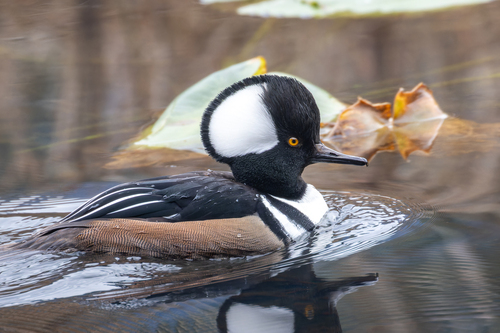
Hooded Merganser
Lophodytes cucullatus
With a spectacular fan-shaped crest and piercing yellow eyes, the Hooded Merganser is one of North America's most striking waterfowl. This small, secretive diver is a master of the wooded swamp, transforming any backyard pond into a theater of wild beauty.
Quick Identification
Size
Length: 40–49 cm (16–19 in); Wingspan: 60–66 cm (24–26 in); Weight: 540–680 g (1.2–1.5 lbs)
Colors
Males feature a large white fan-shaped crest with a black border, black back, and rich cinnamon-brown flanks. Females are a muted grayish-brown with a distinctive reddish-cinnamon crest.
Key Features
- Oversized, fan-like collapsible crest
- Thin, serrated 'sawbill' beak
- Male's striking black-and-white head pattern
- Small, compact diving duck profile
When You’ll See Them
Geographic range
Where Does the Hooded Merganser Live?
Native to North America, the Hooded Merganser is found across much of the United States and southern Canada. They primarily inhabit the eastern half of the continent and the Pacific Northwest, with breeding grounds concentrated in the Great Lakes region and the boreal forests. While they are year-round residents in some temperate areas, many populations migrate to the southern US and coastal regions during the winter to find ice-free water.
Basemap © OpenStreetMap contributors
Behavior
Hooded Mergansers are secretive and agile divers, often found in small groups or pairs rather than large flocks. They are highly active during the day, spending much of their time diving for food using their specialized 'sawbill' to grip slippery prey. Unlike many other ducks, they are remarkably fast fliers and can take off directly from the water without a long running start.
In social settings, they are relatively quiet but display fascinating courtship rituals where males expand their white crests to their fullest extent, shaking their heads to attract females. While they generally avoid high-traffic human areas, they are increasingly common in suburban ponds and wetlands, provided there is enough cover and a steady supply of small fish or crayfish.
EverydayEarth exclusive
Camera Tips
Capturing a Hooded Merganser on camera requires a strategic approach focused on their preferred shoreline habitats. Since these ducks are cavity nesters, one of the best ways to get a close-up is to mount your camera near a nesting box (often the same ones used by Wood Ducks) during the spring. Position the camera at eye-level with the box opening, about 5 to 10 feet away, to capture the dramatic moment when the female enters or when the ducklings eventually leap out.
For pond-side setups, place your camera on a low-profile tripod or a stake just 12-18 inches above the water line. Focus on 'loafing logs'—fallen trees or branches that extend into the water—where these ducks often climb out to preen their feathers and rest. Use a high shutter speed or a fast-trigger video mode, as their movements are quick and their crest-raising displays can happen in a flash.
Because Hooded Mergansers are shy, avoid frequent visits to the camera site. Use a cellular trail camera if possible to monitor activity without disturbing them. Since they are sight-hunters, baiting with food isn't effective; instead, focus on natural pinch points where a creek enters a pond or near thick emergent vegetation where they like to forage for crayfish at dawn and dusk.
Similar Species
Species that look similar or are commonly confused with Hooded Merganser.
Frequently Asked Questions
Record Hooded Merganser at your habitat
Connect a camera to start building your own species record — AI identifies every visitor automatically.