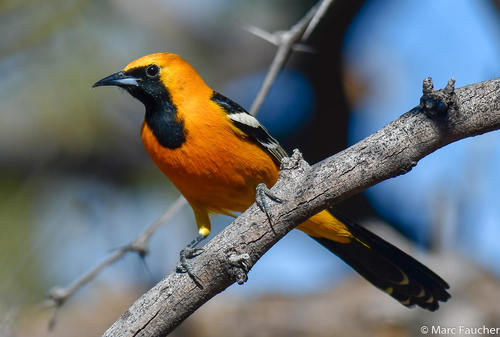
Hooded Oriole
Icterus cucullatus
The 'Palm Leaf Tailor' of the bird world, the Hooded Oriole brings a flash of tropical orange to suburban backyards. Famous for sewing its nest onto palm fronds, this migratory jewel is a favorite for western birders.
Quick Identification
Size
Length 18-20 cm (7-8 in), Wingspan 23-28 cm (9-11 in), Weight 24-28 g (0.8-1.0 oz)
Colors
Males feature a brilliant orange to yellow hood and underparts with a black bib, back, and tail. Females are primarily olive-green above and pale yellow below.
Key Features
- Bright orange or yellow 'hood' covering crown and nape
- Long, slightly downward-curved bill
- Black bib and face mask connecting to a black back
- Frequently found nesting in palm trees
When You’ll See Them
Geographic range
Where Does the Hooded Oriole Live?
Native to the Americas, the Hooded Oriole is a quintessential bird of the desert southwest and coastal California. Its core range extends from the Southwestern United States—particularly California, Arizona, New Mexico, and Texas—southward through the majority of Mexico and into the lowlands of Belize and Guatemala. Interestingly, its range has expanded significantly northward along the Pacific Coast in recent decades, following the widespread human planting of ornamental palm trees in urban landscapes.
Basemap © OpenStreetMap contributors
Behavior
The Hooded Oriole is a master architect of the bird world, famously known for its ability to 'sew' its nest. They are frequently called 'palm-leaf orioles' because they use their sharp, needle-like beaks to pierce the underside of palm fronds, threading long fibers through the holes to hang their woven, basket-like nests. This unique strategy keeps their chicks safe from many climbing predators and sheltered from the sun.
While they can be somewhat shy and prefer to stay within the canopy of trees, they are well-adapted to suburban environments, especially where ornamental palms are present. They are active and acrobatic foragers, often hanging upside down to reach nectar in tubular flowers or to glean insects from the underside of leaves. Unlike some bolder songbirds, they tend to move quietly through the foliage, making them a rewarding 'find' for backyard observers.
EverydayEarth exclusive
Camera Tips
To capture the stunning orange plumage of a Hooded Oriole on your AI camera, focus your efforts on a specialized feeding station. These birds have a well-known 'sweet tooth' and are highly attracted to grape jelly and halved oranges. Mount your camera approximately 5 to 6 feet off the ground, angled slightly downward toward an oriole feeder. Because these birds are larger and have longer tails than typical finches, ensure the camera is positioned about 3 to 4 feet away to keep the entire bird in the frame when it lands.
If your backyard has palm trees—specifically Washingtonia or Fan palms—you have a prime location for nesting activity. Look for the lower, older fronds that provide a 'ceiling' for their nests. You can mount a trail camera to a nearby structure or use a tall tripod to monitor these higher areas. Keep an eye out for 'stitching' marks on the leaves, which are a surefire sign of a nest. Avoid placing cameras too close to the nest site itself to ensure you don't disturb the breeding pair; use a camera with high-resolution digital zoom if possible.
Since Hooded Orioles are also nectar-feeders, they will often visit hummingbird feeders. However, they struggle with the small perches designed for hummingbirds. Providing a nectar feeder with a larger 'oriole-sized' perch will significantly increase your chances of a long, clear video capture. Morning light is your best friend for these birds; try to position your camera so the sun is behind it, illuminating the male's vibrant orange 'hood' during the peak activity hours of 7:00 AM to 9:00 AM.
Similar Species
Species that look similar or are commonly confused with Hooded Oriole.
Frequently Asked Questions
Record Hooded Oriole at your habitat
Connect a camera to start building your own species record — AI identifies every visitor automatically.