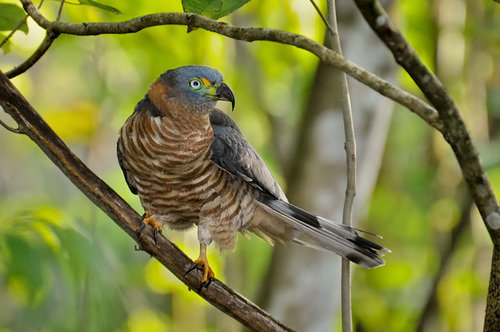
Hook-billed Kite
Chondrohierax uncinatus
With its distinctively oversized bill and striking white eyes, the Hook-billed Kite is the ultimate specialist of the tropical canopy. A rare prize for birders in the U.S. and a fixture of the Latin American wilderness, this raptor is a master at navigating dense foliage to find its favorite meal: land snails.
Quick Identification
Size
Length 38-43 cm (15-17 in); Wingspan 80-95 cm (31-37 in); Weight 215-400 g (7.6-14.1 oz)
Colors
Highly polymorphic; males are typically slate-gray with fine white barring below, while females are brown with a rufous collar. Both have distinctive yellow-green facial skin and a pale white iris.
Key Features
- Massive, deeply hooked bill
- Broad, paddle-shaped wings with a 'pinched' base
- White or pale iris
- Yellow-green lores (facial skin)
- Heavily barred underparts in most color morphs
When You’ll See Them
Geographic range
Where Does the Hook-billed Kite Live?
This unique raptor is native to the Americas, stretching from the tropical reaches of South America up through Central America and Mexico. In the United States, its range is extremely limited, primarily found in the lush riparian corridors of the lower Rio Grande Valley in Texas. From the Caribbean islands of Grenada and Trinidad to the northern borders of Argentina, the Hook-billed Kite thrives in diverse tropical and subtropical landscapes where its specialized food sources are plentiful.
Basemap © OpenStreetMap contributors
Behavior
The Hook-billed Kite is a specialized and somewhat enigmatic bird of prey. Unlike the swift, aerial displays of other kite species, this raptor is often described as methodical or even sluggish. It spends much of its time perched within the mid-to-upper canopy of tropical forests, moving quietly from branch to branch in search of its primary prey: land snails. Because of this sedentary lifestyle, they can be difficult to spot until they take flight, revealing their unusually shaped, broad wings.
Socially, they are usually found alone or in pairs. While they are not particularly aggressive toward humans, they are quite shy and will move deeper into the foliage if they feel watched. They are non-migratory in most of their range, though northern populations in Texas may show some local movement depending on snail availability and weather conditions. Their flight is distinctive, featuring slow, heavy wingbeats that make them look more like a crow or a large owl than a typical raptor.
EverydayEarth exclusive
Camera Tips
Capturing a Hook-billed Kite on camera requires a strategic approach because they rarely descend to the ground. Your best chance for a clear shot is to mount your camera 10 to 20 feet high on a sturdy tree trunk, angled slightly downward toward a known 'snail anvil'—a specific branch or rock where the kite consistently brings snails to extract them from their shells. Look for piles of empty snail shells on the forest floor to identify these foraging hotspots.
Since these birds are diurnal, ensure your camera's trigger speed is set to its fastest setting to catch them as they land or depart. Using a camera with a high-resolution sensor is vital, as the kites often stay within the dappled light of the canopy, which can create challenging exposure conditions. Setting your camera to a higher ISO or using a wider aperture can help compensate for the low-light environment under the forest canopy.
While traditional birdseed doesn't work for these specialists, providing a consistent water source like a high-placed birdbath or a solar-powered dripper in a small clearing can entice them down from the high canopy. During the dry season, these water features become magnets for all tropical raptors. In South Texas, the best months for activity are late spring and early summer when they are feeding chicks and are most active in their search for prey.
Similar Species
Species that look similar or are commonly confused with Hook-billed Kite.
Frequently Asked Questions
Record Hook-billed Kite at your habitat
Connect a camera to start building your own species record — AI identifies every visitor automatically.