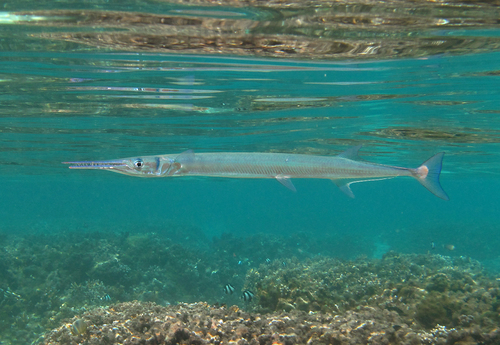
Houndfish
Tylosurus crocodilus
The Houndfish is the undisputed giant of the needlefish family, a silver-scaled hunter that skims the surface of tropical seas. Known for its toothy beak and incredible jumping ability, it is a master of the coastal shallows.
Quick Identification
Size
Grows up to 1.5 meters (5 feet) in length and can weigh up to 4.5 kilograms (10 pounds).
Colors
Dark blue or iridescent blue-green on the back, transitioning to bright silvery sides and a white belly; juveniles may show a dark lateral stripe.
Key Features
- Elongated, beak-like jaws filled with needle-sharp teeth
- Stout, cylindrical body significantly larger than other needlefish
- Distinctive black lateral keel on the caudal peduncle (base of the tail)
- Dorsal and anal fins positioned far back toward the tail
When You’ll See Them
Geographic range
Where Does the Houndfish Live?
The Houndfish is a circumtropical species found in warm waters across the globe. In the Western Atlantic, its range spans from the coast of Massachusetts down through the Caribbean to Brazil, while in the Indo-Pacific, it is commonly found from the Red Sea and East Africa to the Hawaiian Islands and French Polynesia. They are particularly abundant in the clear, shallow waters surrounding the Great Barrier Reef and the Gulf of Mexico.
Basemap © OpenStreetMap contributors
Behavior
The Houndfish is a high-speed, surface-dwelling predator known for its agility and occasionally its explosive leaps out of the water. As the largest member of the needlefish family, it patrols tropical lagoons and coral reefs, often staying just inches below the surface to hunt. While they appear sleek and slender, they are powerful swimmers capable of reaching impressive speeds to overtake smaller fish or escape larger predators like sharks and tuna.
These fish are generally solitary but can be found in small, loose schools during spawning or in areas with high prey density. They are notoriously skittish and are easily startled by sudden movements or bright lights at night. Because they swim so close to the surface, they have been known to leap over floating objects—including boats—which can be hazardous to humans due to their sharp, pointed beaks and significant body weight.
EverydayEarth exclusive
Camera Tips
Capturing the Houndfish requires a specialized approach since they are surface-dwellers. If you have a dock or pier on a coastal property, mount your underwater camera just 6 to 12 inches below the surface. Pointing the lens horizontally or slightly upward will help capture the fish’s silhouette against the natural light. Because they are highly reflective, placing your camera in a spot with dappled sunlight, such as near overhanging mangroves or pier pilings, can help prevent overexposure on their silver scales.
To attract Houndfish to your backyard camera, focus on the ecosystem rather than direct bait. These fish are attracted to movement and schooling baitfish. Installing a low-intensity green underwater light can attract the small fish and crustaceans that Houndfish prey upon. However, be cautious with bright white lights, as Houndfish are known to 'jump' toward intense light sources, which could lead to them striking your equipment or leaping out of the water entirely.
For the best identification shots, use a camera with a high frame rate. Houndfish move with sudden, jerky bursts of speed that can blur on standard trail cameras. If your AI camera supports it, set the trigger sensitivity to high and use a wide-angle lens. Since they often cruise the 'skin' of the ocean, ensuring your lens is kept clean of salt buildup and algae is crucial for maintaining the clarity needed to see their distinctive toothy beaks.
Similar Species
Species that look similar or are commonly confused with Houndfish.
Frequently Asked Questions
Record Houndfish at your habitat
Connect a camera to start building your own species record — AI identifies every visitor automatically.