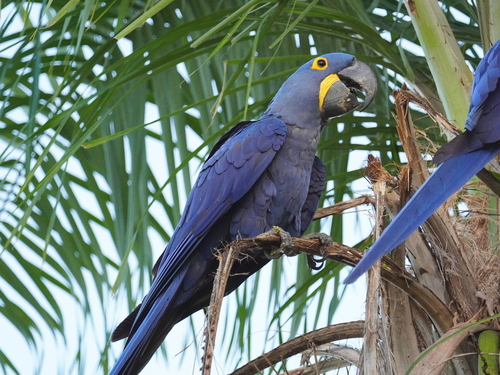
Hyacinth Macaw
Anodorhynchus hyacinthinus
Witness the majesty of the world's largest parrot. With its brilliant cobalt-blue plumage and gentle nature, the Hyacinth Macaw is a true icon of the South American wild.
Quick Identification
Size
Length of approximately 100 cm (39 in); wingspan of 120-140 cm (47-55 in); weight of 1.2-1.7 kg (2.6-3.7 lb).
Colors
Deep cobalt-blue plumage overall; bright yellow rings around the eyes and a yellow patch at the base of the lower mandible; dark grey to black beak and feet.
Key Features
- World's largest flying parrot reaching 1 meter in length
- Vibrant cobalt-blue feathers with no green or red
- Distinctive bright yellow 'goggles' and chin patches
- Massive, deeply curved black beak designed for crushing nuts
When You’ll See Them
Geographic range
Where Does the Hyacinth Macaw Live?
The Hyacinth Macaw is a crown jewel of South America, naturally occurring across three primary regions of the continent's interior. Its most famous stronghold is the Pantanal wetland region of Brazil, extending slightly into eastern Bolivia and northeastern Paraguay. Additional isolated populations exist in the Cerrado plateau of central Brazil and the eastern Amazon basin. While they cover a large geographic area, their distribution is fragmented and strictly tied to the presence of specific palm species and suitable nesting cavities.
Basemap © OpenStreetMap contributors
Behavior
Often referred to as 'gentle giants,' Hyacinth Macaws are highly social and intelligent birds that usually travel in pairs, family groups, or small flocks. They are famous for their loud, raucous calls that can be heard from miles away, which they use to communicate with their mates and maintain group cohesion. Despite their intimidating beak size, they are known for their inquisitive and relatively calm temperament compared to other large macaws.
These parrots spend much of their day foraging in palm groves or resting in the shade of large trees during the hottest hours. They are monogamous and form incredibly strong pair bonds that often last for life. In the wild, they engage in mutual preening and playful interactions, and they are even known to use basic tools, such as using pieces of wood or leaves to prevent palm nuts from slipping while they crack them open.
EverydayEarth exclusive
Camera Tips
To capture the Hyacinth Macaw on a trail camera, focus your efforts on their preferred 'dining rooms.' In the Pantanal, this means placing cameras near Acuri or Bocaiuva palm trees. Look for piles of discarded, cracked nut shells on the ground; this is a 'foraging station' where the birds likely return daily. Mount your camera about 4-6 feet high, angled slightly upward if the birds are feeding on the lower palm fronds, or downward if you've found a ground-level feeding site. Use a camera with a high-speed trigger and a wide-angle lens, as these birds have a massive wingspan that can easily blur or be cut off in tight frames.
Watering holes and 'barreiros' (clay licks) are also prime locations. These birds need to drink and neutralize fruit toxins by eating mineral-rich clay. Because they are social, a single sighting often means a dozen more are nearby, so set your camera to 'Burst Mode' or 'Photo + Video' to capture the full flock dynamic. Avoid using bright white flashes at night if you are monitoring roosting sites, as this can startle the birds and cause them to abandon the area; invisible IR or low-glow LEDs are much better for late-afternoon or early-morning shots.
Protecting your equipment is vital. Hyacinth Macaws are incredibly curious and possess one of the strongest beaks in the bird world. They are known to investigate new objects in their environment by chewing on them. Always use a heavy-duty steel security housing (bear box) for your camera and ensure all cables are tucked away or armored. If they can reach a plastic housing, they can destroy it in seconds. For the best lighting, aim for the golden hours—shortly after sunrise or before sunset—when their cobalt feathers truly shimmer against the green vegetation.
Similar Species
Species that look similar or are commonly confused with Hyacinth Macaw.
Frequently Asked Questions
Record Hyacinth Macaw at your habitat
Connect a camera to start building your own species record — AI identifies every visitor automatically.