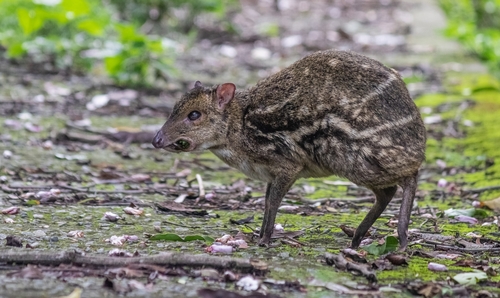
Indian Chevrotain
Moschiola indica
Often called the 'Mouse-deer,' the Indian Chevrotain is a shy, nocturnal marvel of the forest floor. With its miniature size and striking spotted coat, catching one on camera is like finding a living fossil in your backyard.
Quick Identification
Size
Body length 55–60 cm (21.5–23.5 in), weight approx 3 kg (6.6 lb), tail 2.5 cm (1 in)
Colors
Olive-brown upperparts with four to five rows of white spots forming broken stripes; white underparts; three white stripes on the throat
Key Features
- Miniature deer-like frame without antlers
- Arched back with slender, pencil-thin legs
- Distinctive white spots and longitudinal stripes on flanks
- Males have elongated upper canines (tusks) instead of horns
When You’ll See Them
Geographic range
Where Does the Indian Chevrotain Live?
The Indian Chevrotain is native to the Asian continent, specifically across the Indian Peninsula. Its core range spans from the southern tip of India up through the Western and Eastern Ghats into the central Indian forests, and potentially reaching the lowland forests of Nepal. It is a lowland specialist that avoids high-altitude peaks, thriving instead in areas with significant leaf litter and proximity to permanent water sources.
Basemap © OpenStreetMap contributors
Behavior
The Indian Chevrotain, also known as the mouse-deer, is a master of stealth and one of the most primitive ungulates on Earth. They are strictly nocturnal and exceptionally solitary, spending their daylight hours tucked away in hollow logs, rocky crevices, or the densest thickets of the forest floor. They do not form herds, preferring to navigate the undergrowth alone, though they may occasionally be seen in pairs during the brief mating season.
When threatened, these tiny mammals exhibit a unique 'freezing' behavior, relying on their spotted coat to blend perfectly with the dappled light of the leaf litter. If a predator gets too close, they explode into a rapid, zig-zagging run to find a new hiding spot. Their movement is characterized by a high-stepping, delicate gait, as they walk on the very tips of their tiny hooves. Interaction with humans is rare due to their skittish nature and preference for the cover of night.
EverydayEarth exclusive
Camera Tips
Capturing an Indian Chevrotain on camera requires a specialized setup because of their diminutive stature. You must place your camera extremely low—no more than 8 to 12 inches (20-30 cm) off the ground. If the camera is mounted at standard waist height, you will likely only capture the top of their head or miss them entirely as they move through the undergrowth. Angle the lens slightly upward or keep it perfectly level to catch the intricate white spotting on their flanks.
Since they are almost exclusively active after dark, the quality of your camera's infrared flash is critical. Use a 'No-Glow' or 'Black IR' flash to prevent spooking these highly nervous animals. They have large, sensitive eyes and a flash that emits a visible red glow may cause them to flee the area and avoid that specific trail in the future. Set your camera to a fast trigger speed (0.3 seconds or less) to catch them as they dart through the frame.
Focus your efforts on micro-habitats. Look for small, narrow openings in dense brush or natural tunnels through lantana or bamboo thickets. If you are on a plantation or a backyard bordering a forest, placing the camera near fallen fruit—especially wild figs or Indian gooseberry (Amla)—can be a major draw. In dry months, a small ground-level water basin is an excellent attractant. We recommend using 'Burst Mode' (3-5 photos per trigger) or short 15-second video clips to observe their unique, cautious sniffing behavior and high-stepping walk.
Frequently Asked Questions
Record Indian Chevrotain at your habitat
Connect a camera to start building your own species record — AI identifies every visitor automatically.