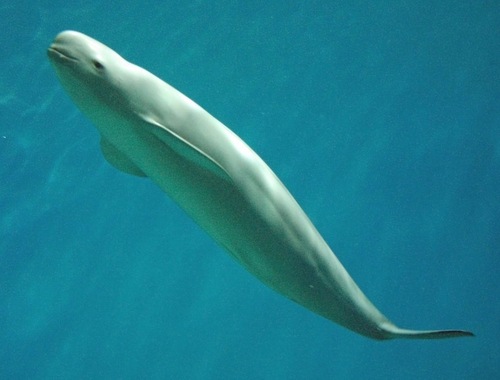
Indo-Pacific Finless Porpoise
Neophocaena phocaenoides
The ghost of the coast, the Indo-Pacific Finless Porpoise is a mysterious, beakless marvel that haunts shallow tropical waters. Lacking a dorsal fin and possessing a quiet, rolling swim style, they are the ocean's most subtle residents.
Quick Identification
Size
Length: 1.2 to 1.9 m (3.9 to 6.2 ft); Weight: 30 to 72 kg (66 to 159 lbs)
Colors
Uniform light gray to steel-gray, sometimes with a bluish tint; paler on the underside
Key Features
- Total absence of a dorsal fin, replaced by a low ridge
- Blunt, rounded head with no protruding beak
- Small, triangular flippers
- Single crescent-shaped blowhole
When You’ll See Them
Geographic range
Where Does the Indo-Pacific Finless Porpoise Live?
The Indo-Pacific Finless Porpoise is native to the warm coastal waters of Asia and the Indian Ocean. Its expansive range stretches from the Persian Gulf in the west, continuing along the coasts of South Asia and Southeast Asia, and extending as far north as the Taiwan Strait. These mammals are true coastal specialists, rarely venturing into waters deeper than 50 meters, making them a fixture of the shorelines of countries like India, Thailand, Vietnam, and Indonesia.
Basemap © OpenStreetMap contributors
Behavior
Indo-Pacific Finless Porpoises are famously shy and elusive compared to their more acrobatic dolphin cousins. Unlike many small cetaceans, they do not 'bow-ride' alongside ships and rarely leap clear of the water. Instead, they exhibit a subtle 'rolling' motion when surfacing to breathe, which makes them incredibly difficult to spot in choppy water. They are typically found in small social groups of one to four individuals, though larger aggregations may form temporarily in areas with abundant food.
These porpoises are highly intelligent and possess a sophisticated sonar system for navigating murky coastal waters. While they generally avoid human contact, they are often found in close proximity to human activity due to their preference for shallow estuaries and mangroves. In some regions, they have been observed following fishing boats to scavenge, though they remain wary of the vessels themselves.
EverydayEarth exclusive
Camera Tips
Capturing an Indo-Pacific Finless Porpoise on camera requires a specialized approach because they spend the vast majority of their lives underwater and lack a dorsal fin to break the surface. If you have a coastal property, pier, or boat, the best setup involves a high-resolution trail camera or an AI-powered marine camera mounted on a stable, elevated platform overlooking calm, shallow water. Aim the camera at a downward angle of 30-45 degrees to capture the 'roll' of the porpoise's back as it surfaces to breathe.
Since these animals are most active in estuaries and mangroves where water can be murky, use a camera with a fast shutter speed (at least 1/1000s) and a polarizing filter. The filter is crucial; it cuts through the surface glare of the ocean, allowing the camera to 'see' the dark shape of the porpoise just beneath the water's edge. Set your AI triggers to detect movement in the upper third of the frame where the water meets the air, and use a 'burst mode' to ensure you catch the split-second moment of the blowhole clearing the surface.
While traditional bait doesn't work for marine mammals, you can increase your chances by placing your camera near natural 'choke points' like the mouths of estuaries during an incoming tide. Porpoises often follow the tide in search of schools of fish. Early morning light or the 'golden hour' before sunset provides the best contrast against the water, making the gray skin of the porpoise stand out against the blue or green sea. Be sure to use a weather-sealed, salt-spray resistant housing for your equipment to prevent corrosion.
Similar Species
Species that look similar or are commonly confused with Indo-Pacific Finless Porpoise.
Frequently Asked Questions
Record Indo-Pacific Finless Porpoise at your habitat
Connect a camera to start building your own species record — AI identifies every visitor automatically.