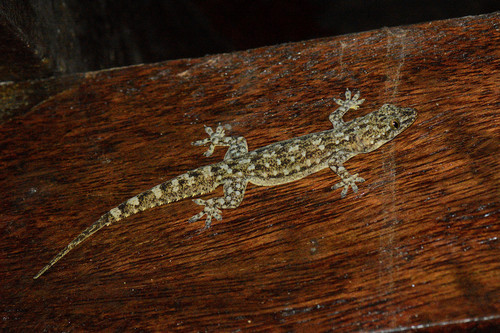
Indo-Pacific House Gecko
Hemidactylus garnotii
Meet the Indo-Pacific House Gecko, the 'fox-faced' hunter of the night. This remarkable all-female species has traveled the globe, using its specialized toe pads and stealthy ambush tactics to become a master of the suburban backyard.
Quick Identification
Size
4 to 5.5 inches (10–14 cm) in total length; weighs approximately 3–6 grams
Colors
Grayish-brown to dark olive-brown back with pale speckling; underbelly is distinctive lemon-yellow to orange; tail may show dark bands
Key Features
- Long, pointed 'fox-like' snout
- Smooth skin lacking the prominent bumpy tubercles of other house geckos
- Flattened tail with serrated edges
- Translucent, waxy appearance when viewed under artificial light
When You’ll See Them
Geographic range
Where Does the Indo-Pacific House Gecko Live?
The Indo-Pacific House Gecko is native to the tropical regions of South and Southeast Asia, extending through the Philippines and across many islands of Polynesia. It has become a widespread introduced species in several other parts of the world, most notably throughout Florida, Hawaii, and southern Georgia in the United States, as well as parts of coastal Australia and the Caribbean. These geckos thrive in warm, humid environments where human structures provide both shelter and a steady supply of insect prey.
Basemap © OpenStreetMap contributors
Behavior
The Indo-Pacific House Gecko is a fascinating nocturnal reptile known for its unique reproductive biology: the species is entirely female. They reproduce through a process called parthenogenesis, meaning they lay fertile eggs without the need for mating. This evolutionary advantage allows a single female to stow away in cargo or nursery plants and start an entirely new population in a new location, contributing to their success as a global traveler.
In the backyard environment, these geckos are much more shy than the aggressive Common House Gecko. While they are often seen near porch lights hunting insects, they are quick to retreat into deep crevices or behind shutters if they sense movement. They are also quite vocal, producing a series of high-pitched chirps or 'ticking' sounds that serve to announce their presence to other females in the area.
EverydayEarth exclusive
Camera Tips
To capture the best footage of an Indo-Pacific House Gecko, your camera should be positioned near a consistent light source, such as a porch light or a bright security lamp. These geckos are 'sit-and-wait' predators that congregate where insects are most abundant. Mount your camera approximately 5 to 6 feet high on a wall, aiming it at the 'glow zone' around the light where moths and flies typically land. Because these geckos are small, a camera with a close-focusing distance or a dedicated macro lens will provide the clearest detail of their smooth, waxy skin.
Since they are active during the darkest hours, ensure your camera's infrared (IR) flash is optimized. These geckos have somewhat reflective, pale skin that can easily 'wash out' in a photo if the IR flash is too close or too bright. To avoid this, place your camera at a slight 45-degree angle to the wall rather than pointing directly at it. This angle creates better shadows and highlights the gecko's slender, fox-like profile. Set your trigger interval to the shortest possible time, as these reptiles move in sudden, lightning-fast bursts when they lunge at prey.
While you don't need traditional bait, you can 'prime' a spot by keeping your outdoor lights on for several nights in a row to establish a feeding pattern. If you are using a trail camera in a more natural setting, look for vertical surfaces with deep cracks or loose bark, which serve as their daytime hiding spots. Placing a camera near these exit points at dusk can capture them as they emerge for their nightly hunt. In cooler months, they will be most active on nights when the temperature stays above 60°F (15°C).
Similar Species
Species that look similar or are commonly confused with Indo-Pacific House Gecko.
Frequently Asked Questions
Record Indo-Pacific House Gecko at your habitat
Connect a camera to start building your own species record — AI identifies every visitor automatically.