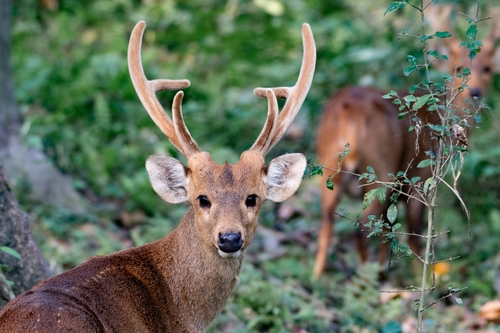
Indochinese Hog Deer
Axis porcinus
A stocky, elusive resident of Asia's floodplains, the Indochinese Hog Deer is named for its unique, low-headed running style. These small but hardy deer are masters of disappearing into the tall grass, making them a prize find for any trail camera enthusiast.
Quick Identification
Size
105–115 cm (41–45 in) in length; 60–70 cm (24–28 in) at the shoulder; 30–50 kg (66–110 lbs)
Colors
Golden-brown to dark sandy-brown coat; white undersides on the tail and belly; fawns are born with white spots that fade with age
Key Features
- Stocky, low-slung build with shorter legs than most deer
- Hog-like running style with head held low
- Short tail with a white underside that is flashed when alarmed
- Small, three-tined antlers found only on males
- Prominent dark dorsal stripe running from the neck to the tail
When You’ll See Them
Geographic range
Where Does the Indochinese Hog Deer Live?
Where Does the Indochinese Hog Deer Live? Native to the vast alluvial plains and river valleys of the Indian subcontinent and Southeast Asia, this species finds its stronghold in the tall-grass wetlands of India, Nepal, Pakistan, and Myanmar. While its range was once contiguous across the Indochinese peninsula, wild populations in Thailand, Laos, and Vietnam have become increasingly rare and fragmented. Beyond its native lands, the Indochinese Hog Deer has proven remarkably adaptable, with established introduced populations now flourishing in the coastal scrublands of Victoria, Australia, and localized areas within the United States and Sri Lanka.
Basemap © OpenStreetMap contributors
Behavior
The Indochinese Hog Deer is a primarily solitary creature, though small groups may congregate in nutrient-rich feeding grounds like freshly burned grasslands or receding floodplains. Unlike many other deer species that leap gracefully over obstacles, the Hog Deer earned its name from its distinctive, swine-like gait. When startled, it ducks its head low and crashes through undergrowth rather than jumping, a strategy perfectly evolved for the dense tall-grass habitats it calls home.
These deer are famously shy and elusive, relying on their keen sense of smell and hearing to avoid predators and humans. They are most active during the crepuscular hours of dawn and dusk, though they may become more nocturnal in areas where human disturbance is high. During the heat of the day, they retreat into thick riverside vegetation to rest, often utilizing regular 'tunnels' through the tall grass to remain hidden while moving between bedding and feeding sites.
EverydayEarth exclusive
Camera Tips
To capture the Indochinese Hog Deer on camera, you must account for their short stature and preference for thick cover. Mount your camera much lower than you would for a Whitetail or Mule deer—ideally between 2 and 3 feet off the ground. If the camera is too high, you risk missing the animal entirely or getting only 'top-down' shots of their backs as they move through the grass. Angle the camera slightly upward if placing it on a slope to ensure the face and antlers are in the frame.
Focus your efforts on 'edge' habitats where tall grasslands meet denser forest or water sources. These deer are creatures of habit and often create well-worn tunnels or paths through thick reeds; look for these flattened corridors and place your camera at the point where the tunnel opens into a clearing or water hole. Because they are shy, use a 'No-Glow' or high-quality IR flash to avoid spooking them at night, as white flashes will often cause them to avoid the area for days afterward.
Set your camera to a fast trigger speed and high sensitivity. Because of their 'hog-like' running style, they can move surprisingly fast through heavy brush, and a slow camera will often result in a 'ghost' or a blurred tail. A multi-shot burst mode (3-5 photos) is highly recommended to catch the deer as it emerges from cover. In areas where it is legal and ethical, a salt lick or mineral block can be an effective lure, as these deer have high mineral requirements, particularly when males are regrowing their antlers.
Similar Species
Species that look similar or are commonly confused with Indochinese Hog Deer.
Frequently Asked Questions
Record Indochinese Hog Deer at your habitat
Connect a camera to start building your own species record — AI identifies every visitor automatically.