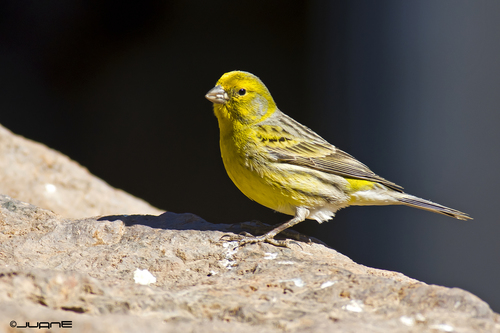
Island Canary
Serinus canaria
The wild ancestor of the world's most beloved pet bird, the Island Canary is a master songster native to the rugged archipelagos of the Atlantic. Its vibrant yellow-green plumage and energetic social life make it a favorite for backyard birdwatchers.
Quick Identification
Size
12.5–13.5 cm (4.9–5.3 in) long; wingspan 20–23 cm (8–9 in); weight 15–20 g (0.5–0.7 oz)
Colors
Yellow-green overall with brown streaking on the back and flanks. Males have brighter yellow faces and breasts; females are generally duller and browner.
Key Features
- Distinctive yellow-green plumage with heavy dark streaks
- Short, conical seed-eating bill
- Notched tail characteristic of finches
- Highly melodic, complex warbling song
When You’ll See Them
Geographic range
Where Does the Island Canary Live?
Native to the Macaronesian archipelagos in the North Atlantic, the Island Canary is found across the Canary Islands, the Azores, and Madeira. Within these island chains, it is a widespread resident that can be found from sea level coastal dunes up to high-altitude pine forests. While the species is famous globally as a cage bird, its wild populations remain restricted to these specific Atlantic island groups, with small introduced populations occasionally reported in Hawaii and Bermuda.
Basemap © OpenStreetMap contributors
Behavior
The Island Canary is a highly social and energetic songbird that often forms large, mobile flocks outside of the breeding season. These flocks move through the landscape in search of food, often communicating with short, rhythmic call notes. In the wild, they exhibit a bounding flight pattern typical of the finch family, alternating rapid wing beats with short glides.
During the spring breeding season, males become territorial and remarkably vocal. They perch on prominent branches or perform song flights to defend their turf and attract mates. Unlike their domestic descendants, wild Island Canaries are more cautious, but they have adapted well to human-modified landscapes and are frequently seen in orchards and suburban gardens.
EverydayEarth exclusive
Camera Tips
To capture the best footage of Island Canaries, focus your camera efforts on water sources. These birds are frequent bathers and will regularly visit shallow bird baths or natural puddles. Set your camera at a low angle, roughly 6 to 12 inches above the water level, to capture the dynamic action of them splashing and preening. Use a fast shutter speed or high-frame-rate video setting (60fps or higher) to avoid motion blur during their rapid movements.
If you are using a feeder to attract them, choose a station that offers niger seed or a high-quality canary seed mix. Place the camera 3 to 5 feet away from the feeder to ensure the bird fills enough of the frame to show off its intricate brown streaking. Because these birds are small and move quickly, a camera with a fast trigger speed (under 0.3 seconds) is essential to avoid capturing empty branches after the bird has already flown away.
Lighting is a critical factor for the Island Canary due to its yellow-green plumage. In harsh midday sun, their colors can appear washed out or overly bright. Aim your camera toward the west during the morning hours or toward the east during the late afternoon to take advantage of the 'golden hour.' This soft, directional light will make their yellow tones pop and provide better definition to the dark streaks on their back.
During the breeding season (March through July), look for the tallest perches in your yard or garden. Males will often return to the same prominent branch to sing for hours. If you can identify a favorite singing post, mount your camera on a nearby branch or tripod directed at that spot. Using a 'Time Lapse' mode with a short interval (5-10 seconds) can also be an effective way to document their behavior if your PIR sensor is struggling to pick up their small body heat signature.
Similar Species
Species that look similar or are commonly confused with Island Canary.
Frequently Asked Questions
Record Island Canary at your habitat
Connect a camera to start building your own species record — AI identifies every visitor automatically.