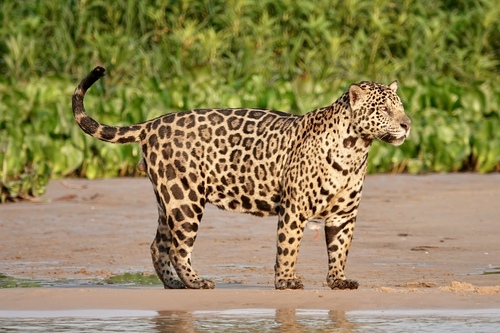
Jaguar
Panthera onca
Witness the undisputed king of the American tropics. With a bite that can crush bone and a coat like dappled sunlight, the jaguar is the ultimate symbol of wild power.
Quick Identification
Size
Body length: 1.1–1.85 m (3.6–6.1 ft); Weight: 56–158 kg (123–348 lb)
Colors
Golden-yellow to tan base with black rosettes containing internal spots; white underbelly; melanistic (all-black) individuals also occur.
Key Features
- Large, blocky head with powerful jaw muscles
- Rosettes feature small central spots (unlike leopards)
- Short, stocky limbs and a thick, muscular tail
When You’ll See Them
Geographic range
Where Does the Jaguar Live?
Jaguars are the only members of the Panthera genus native to the Americas, spanning a vast territory from the southwestern United States down to northern Argentina. They are most commonly found in the dense rainforests of the Amazon Basin and the expansive wetlands of the Brazilian Pantanal. While they were historically found across the southern US, today they are rare visitors to Arizona and New Mexico, with the majority of the population concentrated in Central and South American strongholds.
Basemap © OpenStreetMap contributors
Behavior
The jaguar is a solitary and territorial apex predator, known for being the most aquatic of the big cats. They are exceptional swimmers and frequently hunt in or near water, taking down prey as large as caimans. Unlike many other felines that avoid water, jaguars are right at home in flooded forests and river systems, often using waterways as travel corridors through dense vegetation.
Their social life is largely limited to mating and mother-cub relationships. Jaguars communicate through a variety of vocalizations, including a deep, repetitive cough known as 'sawing' to announce their presence. To the human observer, they are famously elusive and 'ghost-like,' preferring to avoid direct confrontation. However, their physical power is unmatched in their range, possessing a bite force capable of crushing turtle shells and mammalian skulls with ease.
EverydayEarth exclusive
Camera Tips
To capture a jaguar on a trail camera, focus on 'travel corridors' such as well-worn game trails, old logging roads, or the sandy banks of rivers and lagoons. Because jaguars are habitual patrollers, they often use the same paths repeatedly to mark their territory. Position your camera about 24 to 30 inches off the ground—roughly the height of the jaguar’s shoulder—to ensure you get a clear view of their unique rosette patterns, which researchers use for individual identification.
Scent is a powerful motivator for these big cats. While you should never use food bait, which can dangerously habituate predators to human presence, many researchers use 'attractants' like certain colognes (Calvin Klein's Obsession for Men is a scientifically backed favorite) applied to a nearby tree or post. This encourages the cat to linger, rub against the surface, and provide a longer window for high-quality photos or video. Ensure your camera has a very fast trigger speed (under 0.3 seconds) to catch them as they move through the frame.
Settings should be optimized for low-light conditions, as jaguars are often most active during the crepuscular hours of dawn and dusk. Use a high-quality 'No-Glow' infrared flash to avoid spooking the cat or revealing the camera's location. If your camera supports it, set it to 'Hybrid Mode' to capture a high-resolution still followed by a 15-20 second video clip, which is essential for observing their muscular gait and marking behaviors.
Frequently Asked Questions
Record Jaguar at your habitat
Connect a camera to start building your own species record — AI identifies every visitor automatically.