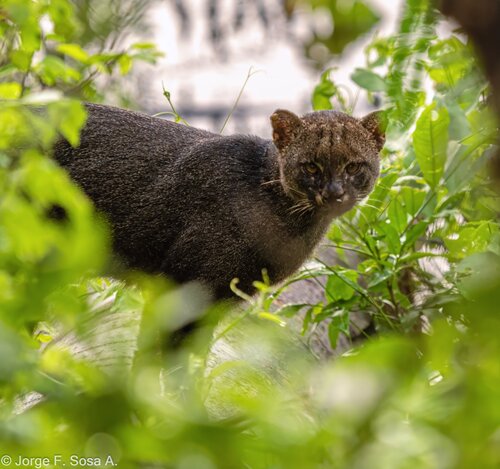
Jaguarundi
Herpailurus yagouaroundi
Often called the 'otter cat' for its elongated body and short legs, the jaguarundi is a master of the daytime shadows. This elusive, solid-colored feline is one of the most unique and rewarding species to track in the wild.
Quick Identification
Size
Body length 53–77 cm (21–30 in); Tail length 31–52 cm (12–20 in); Weight 3.5–7 kg (7.7–15.4 lb)
Colors
Uniform coat without spots; occurs in two distinct color morphs: a dark charcoal gray/brown and a bright reddish-chestnut.
Key Features
- Slender, mustelid-like body with disproportionately short legs
- Small, flattened head with short, rounded ears
- Uniformly colored coat in either gray or red morphs
- Long, thick tail that is nearly as long as the body
When You’ll See Them
Geographic range
Where Does the Jaguarundi Live?
The jaguarundi is native to the Americas, maintaining a vast territory that begins in northern Mexico and extends through Central America into the heart of South America, reaching as far south as central Argentina. While they were historically found in the Lower Rio Grande Valley of south Texas, they are currently considered extirpated from the United States, though unconfirmed sightings in the borderlands continue to fuel hope for their return.
Basemap © OpenStreetMap contributors
Behavior
Unlike most wild cats that prefer the cover of night, the jaguarundi is predominantly diurnal, meaning it is most active during the daylight hours. This unique feline has a social structure that is still being studied, but they are often seen alone or in pairs, exhibiting a more flexible social nature than many of their solitary cousins. They are remarkably agile, capable of moving through dense thorny scrub with ease, and are proficient swimmers when necessary.
Because they are active during the day, jaguarundis are occasionally spotted by hikers or rural residents, though their low-slung profile often leads people to mistake them for large weasels or otters. They are generally shy and will avoid direct human contact, relying on their speed and ability to disappear into thick vegetation. Their vocalizations are unusually diverse for a cat, including whistles, chirps, and purrs that can sound more like a bird than a carnivore.
EverydayEarth exclusive
Camera Tips
To capture a jaguarundi on camera, you must think differently than you would for other cats. Since they are diurnal, you don't need to rely solely on infrared night vision. Position your camera in areas with high light visibility, such as forest edges or openings in dense scrubland where the sun hits the ground. They are relatively low to the ground, so mount your camera lower than usual—about 12 to 15 inches off the forest floor—and angle it slightly upward to capture their full profile and long tail.
Jaguarundis are incredibly fast and agile walkers. To avoid getting a blurry tail or a half-missing shot, use a camera with a fast trigger speed (under 0.3 seconds) and set it to 'burst mode' or 'rapid fire' to take 3-5 photos per trigger event. Because they are often mistaken for tayras or weasels, getting multiple angles is crucial for positive identification. High-resolution video is also highly recommended to capture their unique, fluid movement.
While they are less motivated by traditional baits than some other predators, jaguarundis are naturally curious about unusual sights or sounds. A 'visual lure' like a dangling feather or a piece of shiny foil hanging from a branch can sometimes pique their interest enough to make them pause in front of your lens. Avoid placing cameras in deep, dark forest interiors; instead, focus on transitional zones where thick cover meets a clearing or a stream bank, as these are their preferred hunting corridors.
Similar Species
Species that look similar or are commonly confused with Jaguarundi.
Frequently Asked Questions
Record Jaguarundi at your habitat
Connect a camera to start building your own species record — AI identifies every visitor automatically.