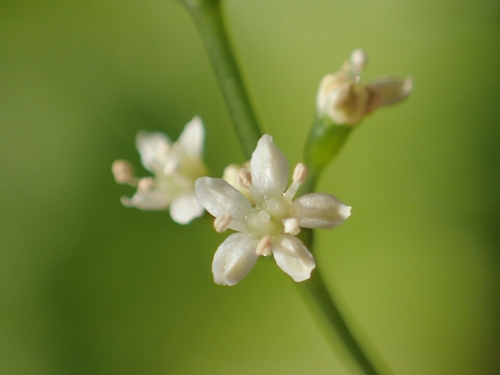
Japanese honewort
Cryptotaenia japonica
A delicate, aromatic treasure of the forest floor, Japanese honewort is as famous for its culinary uses as its beautiful trifoliate leaves. This shade-loving perennial brings a lush, woodland aesthetic to any damp corner of the backyard.
Quick Identification
Size
Stands 30–80 cm (12–32 inches) tall with a spread of 20–60 cm (8–24 inches)
Colors
Bright vibrant green foliage; tiny white flowers; occasional purple-leaved cultivars in gardens
Key Features
- Trifoliate leaves with three heart-shaped leaflets
- Serrated or doubly-toothed leaf margins
- Long, slender, hollow green stems
- Small white flowers in compound umbels
When You’ll See Them
Geographic range
Where Does the Japanese honewort Live?
Native to the temperate regions of East Asia, Japanese honewort is most prevalent throughout the islands of Japan, the Korean Peninsula, and eastern China. It has also become established as an introduced species in parts of North America, particularly in the Northeast and Great Lakes regions, where it colonizes cool, deciduous woodlands. This plant is a signature species of the 'sansai' or mountain vegetable group, often found growing wild near mountain springs and shaded ravines.
Basemap © OpenStreetMap contributors
Behavior
Japanese honewort, widely known as Mitsuba, is a herbaceous perennial that thrives in the quiet, damp shadows of forest floors. Unlike many herbs that crave intense sun, this species is a shade-lover, maintaining its tender texture and aromatic oils best when protected from the midday heat. It grows in loose, attractive clumps, spreading gracefully through underground rhizomes and self-seeding in favorable conditions.
In a backyard setting, the plant acts as a resilient groundcover that signals the health of the soil. It is highly responsive to environmental changes; its leaves will visibly droop during dry spells as a defense mechanism, only to perk up remarkably fast after a rain shower. While it doesn't 'behave' in the animal sense, it provides a vital low-level canopy for forest-floor insects and serves as a larval host for certain butterfly species.
EverydayEarth exclusive
Camera Tips
To get the best images of Japanese honewort, mount your camera on a low-angle stake or a ground-level tripod, aiming for a height of about 10–15 inches. This perspective highlights the unique trifoliate (three-leaf) structure which is its most identifying feature. Because Mitsuba thrives in deep shade, your camera's sensor will be challenged; look for a spot where 'dappled' light hits the leaves during the morning to ensure crisp, vibrant green colors without the graininess of high-ISO night mode.
If you are using an AI-powered camera to monitor growth, set it to time-lapse mode during the spring months of April and May. This allows you to witness the 'unfirling' of the leaves, which is a fascinating botanical process. For those interested in the wildlife that visits the plant, increase the motion sensitivity. While the plant is stationary, the thin stems sway easily in the wind, and small pollinators like hoverflies or the Eastern Black Swallowtail butterfly (which uses related plants as hosts) can be captured if the trigger is fast enough.
Avoid placing the camera too close—maintain a minimum focal distance of at least 2 feet to prevent blurry images. If your camera has a macro setting, use it to capture the compound umbels of tiny white flowers that appear in mid-summer. These flowers are small and easily missed, but they are a hub of activity for microscopic backyard life. Lastly, ensure you clear away any tall, stray grass blades from the immediate foreground to prevent the camera from focusing on moving grass rather than the honewort foliage.
Similar Species
Species that look similar or are commonly confused with Japanese honewort.
Frequently Asked Questions
Record Japanese honewort at your habitat
Connect a camera to start building your own species record — AI identifies every visitor automatically.