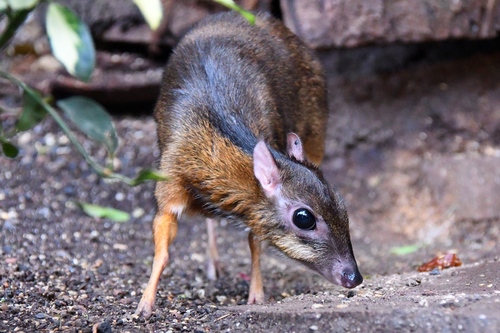
Javan Chevrotain
Tragulus javanicus
The Javan Chevrotain is a living relic of evolutionary history—the world's smallest hoofed mammal, appearing like a cross between a tiny deer and a rabbit. This elusive forest dweller moves through the Javanese shadows with unmatched grace and extreme caution.
Quick Identification
Size
Length: 45–55 cm (18–22 in); Shoulder height: 20–25 cm (8–10 in); Weight: 1.5–2.5 kg (3.3–5.5 lb)
Colors
Reddish-brown or rufous upperparts with a white underbelly; dark nape stripe; distinctive white 'V' or 'Y' shaped markings on the throat.
Key Features
- Miniature, rabbit-sized body with extremely slender legs
- Lacks antlers; males have elongated, tusk-like upper canines
- Large, prominent dark eyes and a moist black nose
- Arched back with a hindquarters higher than the shoulders
When You’ll See Them
Geographic range
Where Does the Javan Chevrotain Live?
Native to the continent of Asia, the Javan Chevrotain is a rare endemic specialist found exclusively on the island of Java in Indonesia. While historical records and local lore suggest they may inhabit the neighboring island of Bali, verified scientific sightings there are virtually non-existent in modern times. Their core range is now restricted to the remaining fragmented forests of Java, particularly within protected national parks and remote mountainous regions where the tropical canopy remains intact.
Basemap © OpenStreetMap contributors
Behavior
The Javan Chevrotain is a famously shy and solitary creature, navigating the dense tropical undergrowth with a delicate, high-stepping gait. Despite being an ungulate (hoofed mammal), it behaves more like a rodent or a rabbit, utilizing 'run-and-hide' tactics to evade predators. When threatened, these tiny deer-like animals are known to rapidly beat their hooves against the ground in a rhythmic drumming pattern, which serves as a warning to others or a distraction to predators.
While they are primarily solitary, they may occasionally be seen in pairs during the breeding season. They are highly territorial, with males using their scent glands located under their chins to mark their home ranges. Because of their small size and secretive nature, they are rarely seen by humans in the wild, often freezing perfectly still at the sound of an approach before darting into the thickest brush available.
EverydayEarth exclusive
Camera Tips
Capturing the Javan Chevrotain requires a specialized approach due to their diminutive stature. You must mount your camera much lower than you would for standard deer; aim for a height of about 20 to 30 centimeters (8-12 inches) off the ground. Angle the camera slightly upward if the terrain is sloped to ensure you capture the throat markings, which are vital for identification. Because they are so small, even minor obstructions like a single large leaf can completely obscure the animal, so clear a small 'stage' in front of the lens.
Placement is everything. Look for 'micro-trails'—tiny, narrow paths through the leaf litter that are too small for larger mammals. These often lead to fallen fruit trees or permanent water holes. In a backyard or garden setting near Javanese forest edges, placing the camera near low-hanging fruit or vegetable patches can be highly effective. They are particularly attracted to the scent of fallen figs or wild berries.
Since these animals are crepuscular and frequently move in low-light conditions, use a camera with a high-quality infrared flash to avoid startling them with white light. A fast trigger speed (under 0.3 seconds) is non-negotiable; mouse-deer are 'twitchy' and move with sudden, jerky bursts of speed. Set your camera to take 'burst photos' or short video clips, as a single still image often only captures the tail-end of the animal as it zips past the frame.
Frequently Asked Questions
Record Javan Chevrotain at your habitat
Connect a camera to start building your own species record — AI identifies every visitor automatically.