Kelp Gull
Larus dominicanus
Meet the Southern Hemisphere's most iconic shorebird, a bold and resourceful master of the coast known for its striking black-and-white plumage and keen intelligence.
Quick Identification
Size
Length: 54-65 cm (21-26 in); Wingspan: 128-142 cm (50-56 in); Weight: 0.9-1.3 kg (2-2.9 lbs)
Colors
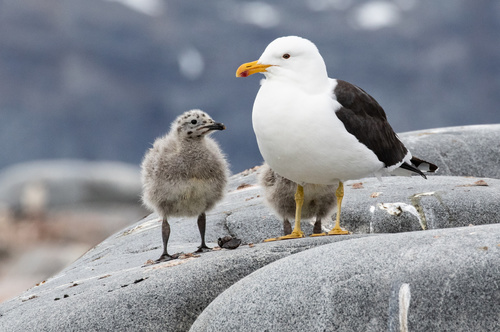
Adults have a pure white head, tail, and underparts with a contrasting slate-black back and wings. They feature a bright yellow bill with a red spot on the lower mandible and greenish-yellow legs. Juveniles are mottled brown and grey.
Key Features
- Slate-black upperparts (mantle)
- Bright yellow bill with a red spot on the lower tip
- Greenish-yellow legs and feet
- Large, robust build with a powerful bill
When You’ll See Them
Sightings on EverydayEarth
May 2, 2026
A vast colony of Southern Giant Petrels is spread across the rocky terrain of Isla Gran Robredo. The majority of the birds are resting on the ground, with several individuals seen preening their feathers or turning their heads. A few Kelp Gulls are interspersed throughout the colony. In the middle of the sequence, a single petrel is observed flying across the upper portion of the frame from right to left.
Apr 28, 2026
Several Kelp Gulls are observed resting along the rocky shoreline and swimming in the ocean. A few gulls take flight, gliding across the frame, while others remain stationary on the ground near empty nesting hollows.
Apr 21, 2026
A large colony of Southern Giant Petrels is scattered across a rocky, arid landscape. Many birds are seen resting on the ground, occasionally preening or shifting their positions. Strong gusts of wind kick up clouds of dust and sand that swirl across the colony. Several birds are also seen soaring through the air in the background.
Apr 20, 2026
A Kelp Gull stands on the rocky shoreline, facing the ocean as waves break in the background. The bird remains mostly stationary, occasionally shifting its weight and turning its head to scan the surroundings. Distant silhouettes of other birds are visible further down the coast.
Apr 18, 2026
A dense colony of Southern Giant Petrels is settled across a rocky landscape. Many birds are resting or nesting on the ground, while several individuals are seen stretching their wings, walking through the group, or flying low across the frame. A Kelp Gull is also active, walking through the colony. The scene is busy with social interactions and maintenance behaviors.
Apr 14, 2026
A Kelp Gull stands on the sandy and rocky shore of Isla Tovita. It remains mostly stationary, occasionally turning its head to look out toward the ocean. In the background, large waves break against the shoreline under a bright, clear sky.
Geographic range
Where Does the Kelp Gull Live?
The Kelp Gull is a true citizen of the Southern Hemisphere, boasting a massive range that spans several continents. They are native to the coastlines of South America, from Ecuador and Brazil down to the tip of Tierra del Fuego, and are the only gull species to breed on the Antarctic Peninsula. These resilient birds are also common sights across Southern Africa, Australia, and New Zealand, where they are often known as Karoro. While primarily coastal, their adaptability has allowed them to establish populations on numerous sub-Antarctic islands and even move further inland in regions like the Andes.
Basemap © OpenStreetMap contributors
Recorded on EverydayEarth
Behavior
The Kelp Gull is a highly intelligent and opportunistic seabird, often seen patrolling coastlines and urban harbors. They are incredibly social, frequently gathering in large, noisy colonies during the breeding season, though they are equally comfortable foraging solo or in small groups along the tide line. They exhibit a fascinating behavior called 'shell-dropping,' where they fly high into the air and drop mollusks onto rocks or pavement to crack them open.
In areas where they overlap with human activity, Kelp Gulls have become remarkably bold. They are notorious for raiding trash cans, following fishing vessels for scraps, and even stealing food directly from picnic tables. Despite their scavenger reputation, they are also skilled hunters, capable of taking live fish from the water's surface or predating on the eggs and chicks of other seabirds.
EverydayEarth exclusive
Camera Tips
Capturing the Kelp Gull on a backyard camera requires a focus on high-traffic areas near water or food sources. If you live near the coast, position your camera on a low tripod or a sturdy post facing a flat, open area like a lawn or a rooftop where these birds frequently land to rest. Since they are large birds, a wide-angle lens is preferred to capture their full wingspan if they take off suddenly. Set your camera height to about 2 to 3 feet off the ground for the most intimate eye-level shots.
Timing is crucial for the best lighting; the Kelp Gull’s white plumage is prone to 'blowing out' or overexposing in harsh midday sun. To get the best results, configure your camera to be most active during the golden hours of dawn and dusk. This will bring out the texture in their black feathers and the vivid yellow of their bills. If your camera has adjustable exposure settings, consider underexposing by a stop to preserve the detail in their bright white heads.
While we don't recommend feeding wildlife, Kelp Gulls are naturally curious and will investigate new objects. Placing a birdbath or a large, shallow water feature in the frame can attract them for bathing sequences, which make for high-action footage. Be aware that these are large, powerful birds; ensure your camera housing is secure and the mounting is rigid, as they have been known to peck at or even try to move shiny objects that catch their eye.
Similar Species
Species that look similar or are commonly confused with Kelp Gull.
Frequently Asked Questions
Record Kelp Gull at your habitat
Connect a camera to start building your own species record — AI identifies every visitor automatically.