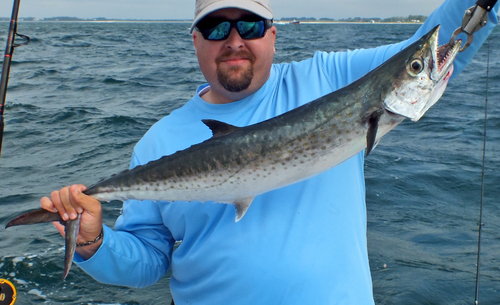
King Mackerel
Scomberomorus cavalla
The King Mackerel is a silver-streaked powerhouse of the Atlantic, famous for its high-speed aerial strikes and migratory journeys. Often called 'Smokers' for their blistering speed, these predators are a true marvel of marine engineering.
Quick Identification
Size
Typically 5–14 kg (11–30 lbs) but can reach 45 kg (100 lbs); length ranges from 50–180 cm (20–71 inches).
Colors
Iridescent bluish-green or gray on the back, fading to silvery sides and a white belly; juveniles may have faint bronze spots.
Key Features
- Lateral line drops sharply below the second dorsal fin
- Deeply forked, powerful tail
- Streamlined, torpedo-shaped body
- Large mouth with closely set, razor-sharp teeth
When You’ll See Them
Geographic range
Where Does the King Mackerel Live?
The King Mackerel is a quintessential species of the Western Atlantic Ocean, with a native range extending from the coast of Massachusetts down through the Gulf of Mexico and the Caribbean Sea to southern Brazil. They are most densely populated in the warm, subtropical waters of the United States south of Cape Hatteras and throughout the entire Gulf Coast. As a migratory species, they shift their core range seasonally, seeking out water temperatures between 20°C and 29°C.
Basemap © OpenStreetMap contributors
Behavior
King Mackerel are formidable pelagic predators known for their incredible speed and schooling nature. They are highly migratory, moving in large groups along the coastlines of the Western Atlantic, following warm water currents and the seasonal movements of their prey. While they spend much of their time in the open ocean, they frequently move nearshore to feed around reefs, wrecks, and piers, where they are often observed by coastal residents and anglers.
These fish are known for their spectacular "sky-rocketing" behavior, where they strike prey from below with such force that they launch themselves 10 to 20 feet out of the water. They are generally solitary as they grow larger—often called "smokers" for the way they peel line off a reel—but smaller individuals, known as "snakes," congregate in massive schools. Interactions with humans are primarily through the fishing industry, where they are a prized catch, though they are generally wary of divers and loud boat motors.
EverydayEarth exclusive
Camera Tips
To capture King Mackerel on an AI-powered camera, you must focus on underwater placement near coastal structures. If you have access to a pier, dock, or boat, submerging a camera 2 to 5 meters below the surface is ideal. Because King Mackerel are pelagic and rarely stop to investigate static objects, you should use a visual lure to bring them into the frame. Suspending a shiny metal flasher or a silver spoon a few feet from the camera lens will mimic the flash of a baitfish, triggering the King Mackerel's predatory instinct to investigate.
Technical settings are critical for this species due to their extreme speed. King Mackerel can strike at speeds exceeding 30 mph, so set your camera to at least 60 frames per second (fps) to avoid a blurry image. High-resolution settings are also beneficial because the silver scales of the fish can cause "blown-out" highlights in bright sun; polarizing filters on your underwater housing can help manage this glare and improve the AI's ability to recognize the fish's profile.
Timing is everything when tracking these migrators. They are most active during the "golden hours" of dawn and dusk when they move toward the surface to hunt. Use an AI system that supports motion-triggering even in high-flow environments. During the spring and fall migrations, focus your efforts on days with high water clarity (low turbidity), as the King Mackerel relies on sight to hunt and will be more likely to approach your lure in clear blue water.
Similar Species
Species that look similar or are commonly confused with King Mackerel.
Frequently Asked Questions
Record King Mackerel at your habitat
Connect a camera to start building your own species record — AI identifies every visitor automatically.