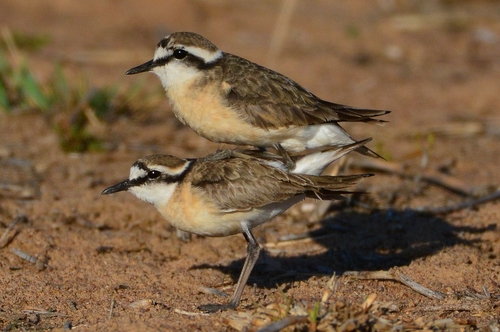
Kittlitz's Plover
Anarhynchus pecuarius
A master of camouflage with a secret nesting trick, the Kittlitz's Plover is one of Africa's most charismatic small shorebirds. Watch as this energetic runner darts across sun-baked flats and suburban lawns with lightning speed.
Quick Identification
Size
Length: 12-14 cm (4.7-5.5 in); Wingspan: 36-39 cm (14-15 in); Weight: 25-45 g (0.9-1.6 oz)
Colors
Pale sandy-brown upperparts, white underparts with a warm buff-orange wash on the breast; black forehead band and a dark eye-stripe that wraps around the nape; monomorphic (males and females look similar)
Key Features
- Distinct black mask through the eye to the back of the neck
- White forehead patch set against a black band
- Long, dark greyish-blue legs
- Warm buff or yellowish wash on the breast
- Small, slender black bill
When You’ll See Them
Geographic range
Where Does the Kittlitz's Plover Live?
This resilient shorebird is a hallmark of the African landscape, stretching across nearly the entire Sub-Saharan region. From the lush Nile Delta in Egypt down to the southern tip of South Africa and across the island of Madagascar, the Kittlitz's Plover thrives in diverse environments. While they are most concentrated in Eastern and Southern Africa, they are also frequently spotted throughout the Sahel and coastal West Africa.
Basemap © OpenStreetMap contributors
Behavior
Kittlitz’s Plovers are energetic and fast-moving shorebirds, often observed in a characteristic "run-and-stop" foraging pattern. Unlike many of their relatives, they are frequently found far from water in dry, open habitats with very short grass or bare soil. They are highly territorial during the breeding season but can form loose, sociable flocks during the rest of the year, often mixing with other small waders at communal roosting sites.
One of their most fascinating behaviors is their unique nesting strategy. When an adult senses a predator nearby, it doesn't just fly away; it quickly uses its feet to kick sand or loose soil over its eggs, completely concealing them in seconds before retreating to a safe distance. This remarkable camouflage allows the nest to remain hidden in plain sight on the open ground. They are also known for "broken-wing" displays to lure threats away from their chicks.
EverydayEarth exclusive
Camera Tips
To successfully capture Kittlitz's Plover on a trail camera, you must focus on ground-level placement. These birds spend almost all of their time on foot, so mounting your camera just 10-15 centimeters (4-6 inches) off the ground is essential for a natural perspective. Aim for wide-open spaces with minimal ground cover, such as a backyard with very short grass or a sandy area near a garden pond. Because they are small and move very quickly, a camera with a fast trigger speed (0.2 seconds or less) is highly recommended.
While they don't visit traditional bird feeders, you can attract them by creating a 'micro-habitat' in your camera's field of view. A shallow, ground-level birdbath or a patch of damp mud in an otherwise dry yard can be a magnet for these birds, as it attracts the insects they feed on. If you are using an AI-powered camera, position it to face North or South to avoid lens flare during the early morning and late afternoon when the birds are most active.
During the breeding season, keep an eye out for their sand-kicking behavior. If you notice a plover frequently visiting a specific patch of bare earth, it may have a nest nearby. Setting your camera to 'Burst Mode' or high-definition video will help you document their fascinating egg-concealment ritual. Always ensure the camera is well-camouflaged with local sand or dry grass, as these birds have keen eyesight and may be wary of large, dark objects placed in their open territories.
Similar Species
Species that look similar or are commonly confused with Kittlitz's Plover.
Three-banded Plover
Features two distinct black breast bands and a prominent red eye-ring, unlike the Kittlitz's single buff breast wash.
White-fronted Plover
Generally paler overall and lacks the dark line that extends from the eye around to the back of the neck.
Kentish Plover
Has a full white collar and lacks the warm orange-buff coloration on the underparts seen in Kittlitz's.
Frequently Asked Questions
Record Kittlitz's Plover at your habitat
Connect a camera to start building your own species record — AI identifies every visitor automatically.