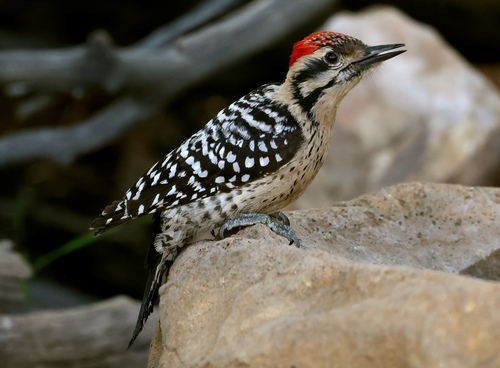
Ladder-backed Woodpecker
Dryobates scalaris
The desert's industrious carpenter, the Ladder-backed Woodpecker is a master of survival in the arid landscapes of the American Southwest and Mexico.
Quick Identification
Size
Length: 6.5–7.5 in (16.5–19 cm), Wingspan: approx 13 in (33 cm), Weight: 0.7–1.7 oz (21–48 g)
Colors
Black and white horizontal 'ladder' bars on the back; white face with black stripes; males have a red crown, females have a black crown
Key Features
- Distinctive horizontal black and white barring on the back
- White underparts with black spots on the flanks
- Male features a red crown patch that does not reach the forehead
- Small, chiseled bill suited for arid-land foraging
When You’ll See Them
Sightings on EverydayEarth
Jun 8, 2026
A male House Finch is already present, feeding on the platform feeder on the right. Shortly into the clip, a male Ladder-backed Woodpecker flies into the frame from the left and perches on the tube feeder, showcasing its barred plumage and red crown.
Geographic range
Where Does the Ladder-backed Woodpecker Live?
Native to North and Central America, the Ladder-backed Woodpecker is a quintessential bird of the arid Southwest. Its core range extends from the southwestern United States—specifically through Texas, New Mexico, Arizona, and Southern California—deep into the heart of Mexico and southward into Central American countries like Guatemala and Honduras. These birds are permanent residents across their range, rarely wandering far from their established territories regardless of the season.
Basemap © OpenStreetMap contributors
Behavior
The Ladder-backed Woodpecker is a hardy and active bird, often seen hitching its way up the trunks of desert trees, yuccas, and even large cacti. Unlike many of its relatives that shy away from open spaces, this species is well-adapted to arid environments and is frequently found in suburban desert gardens. They are known for their quiet, rhythmic tapping as they search for food, rather than the loud, explosive drumming common in larger woodpeckers.
These birds are generally solitary or found in pairs, maintaining year-round territories. They are relatively approachable and have adapted well to human presence, often visiting backyard feeders or birdbaths. During the breeding season, they excavate nest cavities in soft-wooded trees or agave stalks, which are often reused by other desert-dwelling birds in subsequent years.
EverydayEarth exclusive
Camera Tips
To capture the best footage of a Ladder-backed Woodpecker, mount your camera at eye level—roughly 4 to 6 feet high—on a vertical trunk of a mesquite, oak, or even a sturdy fence post. Because they are desert specialists, they are highly attracted to water. Placing a camera near a birdbath or a solar-powered dripper is one of the most effective ways to guarantee a close-up encounter, especially during the heat of the afternoon.
If you are using bait to attract them, high-quality suet is the gold standard. In warmer climates where these birds live, be sure to use 'no-melt' suet blocks to prevent a mess in the sun. Position the feeder within three feet of the camera lens to capture the intricate details of their barred feathers. They are also known to investigate agave stalks and prickly pear cactus fruit, so a camera angled toward these natural food sources can yield stunning, naturalistic footage.
Set your camera to take short video bursts (10-15 seconds) rather than just stills. These woodpeckers have fascinating head movements and foraging techniques that are better captured in motion. Since they are active early in the morning, ensure your camera's white balance is set to handle the golden hour light, which beautifully highlights the red crown of the males.
Similar Species
Species that look similar or are commonly confused with Ladder-backed Woodpecker.
Nuttall's Woodpecker
Very similar in appearance but restricted mostly to California; has less white on the face and a different red pattern on the male's head.
Downy Woodpecker
Smaller with a much shorter bill and a solid white patch down the center of the back rather than horizontal bars.
Hairy Woodpecker
Larger with a significantly longer bill and a solid white back patch instead of the 'ladder' bars.
Frequently Asked Questions
Record Ladder-backed Woodpecker at your habitat
Connect a camera to start building your own species record — AI identifies every visitor automatically.